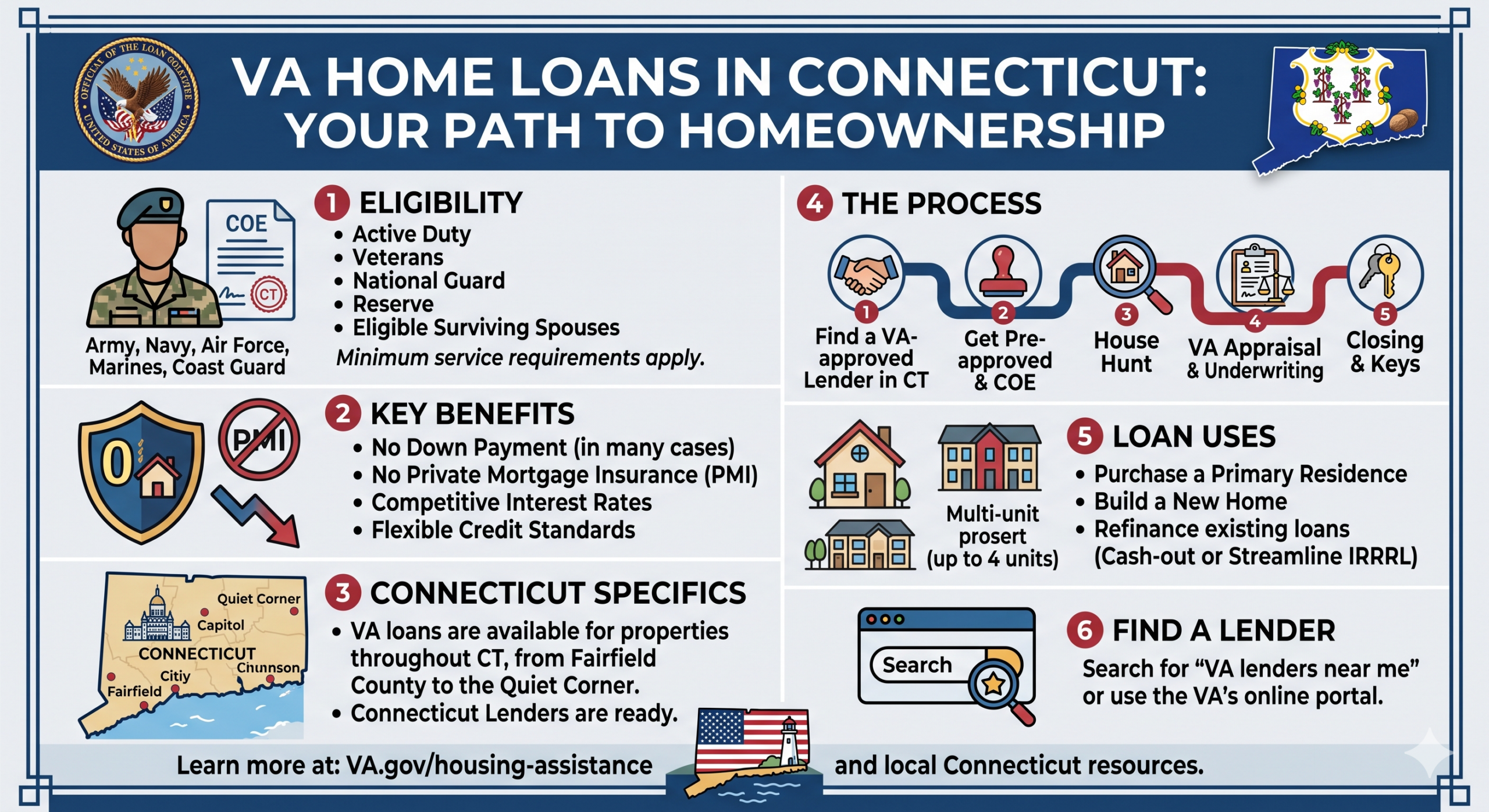
For military veterans, active-duty service members, and eligible surviving spouses living in Connecticut, the VA home loan program represents one of the most significant financial benefits earned through military service.
Backed by the U.S. Department of Veterans Affairs, this program bypasses the traditional barriers of homeownership. In a state like Connecticut—where property values can be steep, municipal taxes are a major monthly variable, and historic homes present unique maintenance profiles—the VA loan offers unmatched advantages, starting with a true $0 down payment requirement and no monthly mortgage insurance.
Evaluating a VA loan in Connecticut requires looking at federal eligibility mechanics, regional conforming limits, property inspection rules, state-level enhancements through the Connecticut Housing Finance Authority (CHFA), and the strategic calculations that determine your ultimate cost.
Call William Lavigne on his cell for the fastest service: 860-585-6285
connecticut1@gmail.com
1. The Core Architecture of the VA Loan Guarantee
The fundamental design of a VA loan mirrors the structure of an FHA loan, but with far more favorable terms for the borrower. The Department of Veterans Affairs does not operate as a brick-and-mortar financial institution; it does not issue capital or underwrite individual applications. Instead, private mortgage companies, commercial banks, and credit unions supply the money, while the VA provides a federal guarantee to the lender.
Under this system, the VA guarantees up to 25% of the total loan amount if the veteran defaults on their mortgage.
-
The Private Lender Perspective: Because the federal government guarantees a quarter of the loan balance against total loss, private financial institutions feel secure waiving the standard 20% down payment requirement.
-
The Conventional Comparison: If a civilian buyer puts 0% down on a conventional loan, the lender’s risk is massive, making the loan impossible to secure under standard guidelines. The VA guarantee completely fills that risk gap.
2. Navigating the “No Loan Limit” Framework
A major milestone for the program occurred via the Blue Water Navy Vietnam Veterans Act, which altered how maximum loan amounts are calculated.
Full Entitlement vs. Partial Entitlement
If you have full entitlement—meaning you have never used your VA loan benefit before, or you have successfully paid off a previous VA loan in full and sold the property—there is no maximum VA loan limit.
You can purchase a home in Connecticut at any price point—whether a $350,000 ranch in Manchester or a $1.5 million estate in Greenwich—with zero money down, provided your income, credit score, and debt profile satisfy the lender’s underwriting benchmarks. The VA does not restrict the purchase price; it simply guarantees 25% of whatever total balance the lender feels confident approving.
However, if you have partial entitlement—typically because you currently own a home with an active VA loan and want to buy a second primary residence in Connecticut without selling the first—your zero-down purchasing capacity is capped by regional Conforming Loan Limits (CLL).
Connecticut Regional Limits
For borrowers bound by remaining entitlement limits, the VA aligns its maximum zero-down caps directly with the Federal Housing Finance Agency (FHFA) conforming loan limits. In Connecticut, these limits are tracked by planning regions rather than historical counties:
| Connecticut Planning Region | 2026 Conforming / VA Limit (1-Unit) |
| Standard Baseline Regions (e.g., Capitol, New Haven, New London, Litchfield) | $832,750 |
| Naugatuck Valley Planning Region (e.g., Waterbury, Shelton, Ansonia) | $851,000 |
| Greater Bridgeport & Western CT Regions (e.g., Fairfield, Stamford, Norwalk) | $977,500 |
If a partial-entitlement veteran buys a home above these specified limits, they aren’t rejected; instead, they must make a down payment equal to 25% of the difference between the home’s purchase price and their remaining regional entitlement tier.
3. Financial Mechanics: No PMI vs. The VA Funding Fee
The most substantial month-to-month cost advantage of a VA loan is the complete elimination of Private Mortgage Insurance (PMI) or monthly Mortgage Insurance Premiums (MIP).
On a conventional or FHA loan with a minimal down payment, buyers must pay an extra $150 to $400 every month for mortgage insurance. With a VA loan, that fee is completely removed from the equation, giving veterans significantly more purchasing power for the same monthly payment.
The VA Funding Fee Breakdown
To keep the loan program self-sustaining and reduce the burden on taxpayers, Congress requires most borrowers to pay a one-time, upfront fee known as the VA Funding Fee. This fee is calculated as a straight percentage of the base loan amount and varies based on whether it is your first use of the benefit and how much money you choose to put down.
| Down Payment | First-Time Use Fee | Subsequent Use Fee |
| 0% Down Payment | 2.15% | 3.30% |
| 5% to 9.9% Down Payment | 1.25% | 1.25% |
| 10% or More Down Payment | 1.05% | 1.05% |
Funding Fee Implementation Math
Just like the FHA upfront premium, the VA funding fee does not require cash out of pocket on closing day. The lender can roll the fee directly into the total principal balance of the mortgage.
For example, if an eligible veteran uses their VA benefit for the first time to buy a $400,000 single-family home in Middletown with 0% down:
-
Base Loan Amount: $400,000
-
Funding Fee Calculation:
-
Total Financed Balance: $408,600
The veteran’s interest charges and monthly principal payments will be calculated using this total adjusted balance of $408,600.
Total Exemption Status
Many veterans are completely exempt from paying the VA Funding Fee. If you meet any of the following criteria, the fee is reduced to 0%, making the VA loan an entirely fee-free mortgage vehicle:
-
You receive any percentage of monthly VA disability compensation for a service-connected condition.
-
You are eligible to receive VA disability compensation but receive active military retirement pay instead.
-
You are a surviving spouse of a service member who died in service or from a service-connected disability.
-
You are an active-duty service member who has a documented, pre-discharge disability rating.
4. Underwriting Parameters and the “Residual Income” Test
While VA loans offer significant flexibility, they are not automatic approvals. Underwriters review files against specific financial criteria, paying close attention to an asset metric unique to VA loans: residual income.
Credit Score Expectations
The Department of Veterans Affairs has no official minimum credit score requirement. However, because private lenders manage the actual transactions, they apply their own guidelines (lender overlays). Most VA lenders in Connecticut look for a minimum credit score of 580 to 620 for standard approvals. If your score clears 720, you will unlock the lowest baseline interest rates available on the market.
Debt-to-Income (DTI) and the Residual Income Override
The VA uses a baseline target DTI ratio of 41%. However, this threshold is soft. It is common for underwriters to approve VA loans with DTIs well north of 50%, provided the borrower passes the VA Residual Income Test.
Residual income is the amount of net monthly income left over after all primary obligations are paid. This includes housing expenses, credit card minimums, auto loans, payroll taxes, and estimated maintenance costs. The VA wants to ensure your family has enough real cash left over to pay for daily necessities like groceries, gasoline, and clothing.
The United States is divided into regional residual cost brackets. Connecticut falls under the Northeast Region. The baseline residual income requirements scale according to family size and loan amounts:
Northeast Regional Monthly Residual Requirements (Loans > $80,000)
  │
  ├── Family Size 1: $475
  ├── Family Size 2: $799
  ├── Family Size 3: $962
  ├── Family Size 4: $1,025
  └── Family Size 5+: Add $80 per additional dependent
If a veteran’s DTI is high (e.g., 48%) but their gross income is substantial enough that their remaining monthly residual cash clears the Northeast regional requirement by 20% or more, the automated underwriting system will routinely issue a clean approval.
5. The VA Property Inspection: Minimum Property Requirements (MPRs)
When buying a home in Connecticut with a VA loan, the property must pass a specialized appraisal that evaluates both fair market value and adherence to the VA’s Minimum Property Requirements (MPRs).
The core mission of the VA appraisal is to confirm that the real estate is safe, sanitary, and structurally sound. Because Connecticut features historic residential architecture, properties often run into specific friction points during the MPR review.
Common MPR Roadblocks in Connecticut
-
Heating Systems in New England Winters: The home must feature a permanently installed heating source capable of maintaining a temperature of at least 50 degrees Fahrenheit in all living spaces. Space heaters or wood-burning stoves alone do not satisfy the requirement.
-
Peeling Lead Paint: For any home built before 1978, all cracking, peeling, or scaling paint on interior or exterior surfaces must be completely scraped, primed, and sealed. This rule is strictly enforced due to the health risks of lead paint.
-
Roof and Attic Scrutiny: The roof must be leak-free and have a reasonable remaining life expectancy (typically at least two years). Underwriters will check that the attic has proper ventilation to prevent ice damming, a common winter issue in Connecticut.
-
Water and Sewage Separation: If the home uses a private well and septic tank system—common in rural parts of Litchfield, Windham, and Tolland counties—the VA requires a water safety test. Additionally, the well must meet strict distance separation rules from the septic tank and leach fields.
-
Termite and Pest Inspections: Connecticut is located in a geographic zone susceptible to wood-destroying insects. The VA requires a mandatory pest inspection report. If active termites, carpenter ants, or powderpost beetles are discovered, the home must be treated, and any structural damage must be repaired before closing.
6. Connecticut State Enhancements: Combining VA with CHFA
The Connecticut Housing Finance Authority (CHFA) runs state-backed mortgage programs designed to complement federal housing benefits. For qualified military members and veterans, these state programs can make buying a home even more affordable.
The Military Homeownership Program
CHFA offers a specialized Military Homeownership Program that stacks directly on top of a standard VA loan.
-
The Interest Rate Cut: Eligible veterans, active-duty service members, and National Guard personnel receive an additional 0.125% reduction off CHFA’s already below-market interest rates.
-
The Targeted Area Multiplier: If the property being purchased is located within a state-designated “Targeted Area” (neighborhoods targeted for economic revitalization), the interest rate discount increases to 0.25%. Furthermore, if you buy in a Targeted Area, CHFA waives its standard first-time homebuyer requirement.
Program Eligibility Guidelines
To leverage the CHFA Military program alongside your VA loan, you must meet basic state limits:
-
Primary Residence Requirement: The home must be a single-family residence, townhome, or VA-approved condominium where you intend to live full-time. Vacation homes and standard commercial investment properties are prohibited.
-
Income and Purchase Price Caps: Your total household income and the purchase price of the home must fall within the maximum boundaries established for that specific Connecticut planning region.
7. Step-by-Step Guide to Executing a Connecticut VA Loan
Securing a VA loan requires clear communication between federal agencies, state programs, and local professionals.
The VA Loan Timeline
  │
  ├── 1. Pull the Certificate of Eligibility (COE)
  ├── 2. Target a VA-Approved Property (Check Condo Registries)
  ├── 3. Execute the Contract & VA Escape Clause
  └── 4. Navigate Underwriting, MPRs, and Closing
1. Pull the Certificate of Eligibility (COE)
Your Certificate of Eligibility is the official document from the federal government proving you are eligible for the housing benefit and showing how much entitlement you have available. Your lender can pull this document instantly from the VA’s online portal using your military discharge paperwork (DD-214) or active-duty statement of service.
2. Verify Condominium Approvals
If you are looking to buy a condominium—such as those found across Hartford, Stamford, or Norwalk—the condo complex must be officially approved by the VA. The VA maintains an online database of approved complexes. If a building is not on that list, your lender cannot issue a VA loan for it unless the condo association goes through a formal review process, which can add weeks to your timeline.
3. Include the VA Escape Clause in Your Contract
When your real estate agent drafts your purchase contract, Connecticut law requires standard real estate disclosures. For VA loans, you must also include the federal VA Escape Clause. This protective clause states that if the formal VA appraisal comes back lower than the agreed-upon purchase price, you can back out of the transaction with your full earnest money deposit intact, without penalty.
4. Close the Transaction
Once the appraiser confirms the home meets all Minimum Property Requirements and the underwriter grants a “Clear to Close,” your closing attorney will prepare the final paperwork. On closing day, you will sign your loan documents, pay any remaining non-allowable closing costs, and take ownership of your new home.
Final Strategic Comparison: VA vs. Conventional and FHA
Choosing the right mortgage depends on your unique financial profile, but for eligible military families, the VA loan is almost always the clear winner.
-
Compared to Conventional: A conventional loan requires a 20% down payment to avoid monthly mortgage insurance. A VA loan allows you to put 0% down with no monthly insurance fees whatsoever. This keeps significantly more cash in your bank account on closing day.
-
Compared to FHA: An FHA loan requires a 3.5% down payment and charges a monthly mortgage insurance premium that usually lasts for the entire life of the loan. A VA loan bypasses the down payment entirely and carries no ongoing insurance fees, saving you thousands of dollars over the years.
If you have earned access to the VA loan program through your military service, pairing this federal benefit with Connecticut’s state-level CHFA programs provides one of the most affordable pathways to homeownership available in today’s housing market.
Call William Lavigne on his cell for the fastest service: 860-585-6285
connecticut1@gmail.com