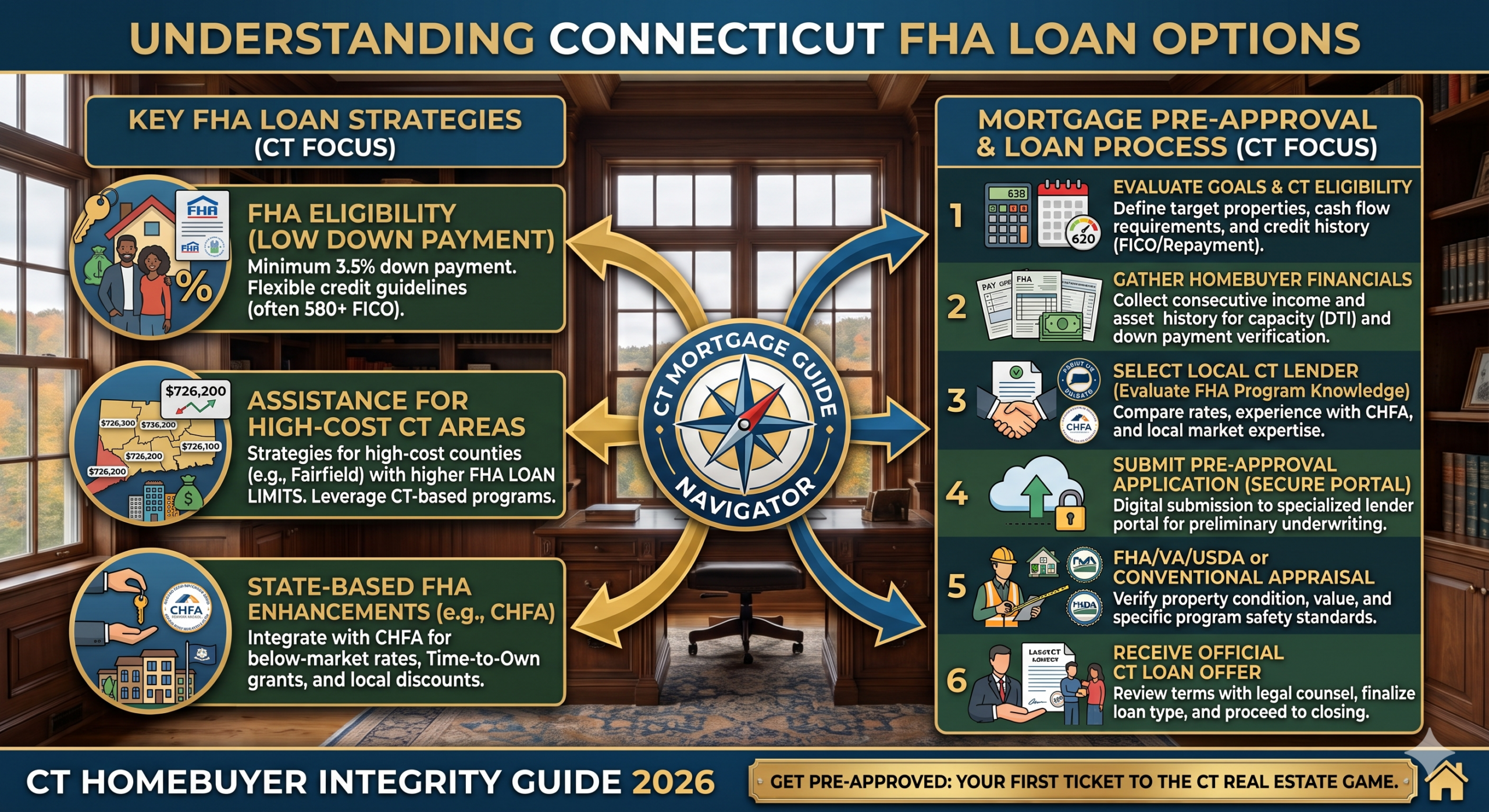
 In the landscape of American real estate, the Federal Housing Administration (FHA) loan program stands as one of the most powerful tools for expanding homeownership. This is especially true in Connecticut, a state characterized by a unique economic and geographic profile: high average incomes, pockets of steep property valuation, an aging housing stock, and dense municipal centers.
Because an FHA loan is backed by the federal government, private lenders in Connecticut can extend financing to individuals who do not fit the strict box of conventional underwriting. For buyers facing the high cost of entry in the Nutmeg State—whether looking at a historic multi-family home in New Haven, a suburban tract in Hartford County, or a property in Fairfield County—understanding how FHA loans function locally is crucial.
1. The Anatomy of an FHA Loan: Government Insurance vs. Direct Lending
A common misconception is that the Federal Housing Administration acts as a direct bank, issuing capital and cutting checks to homebuyers. It does not. Instead, the FHA operates as an insurance provider for private financial institutions.
When a borrower secures an FHA mortgage through an approved bank, credit union, or online lender in Connecticut, the FHA guarantees that if the borrower defaults, the government will reimburse the lender for its losses. This federal cushion shifts the risk dynamic:
-
Conventional Financing Risk: Borne almost entirely by the private lender or private mortgage insurance companies. Hence, guidelines are rigid to shield capital.
-
FHA Financing Risk: Absorbed primarily by the Mutual Mortgage Insurance Fund, managed by the Department of Housing and Urban Development (HUD).
Because the lender’s downside is capped, they can offer flexible qualification metrics, including lower credit thresholds and smaller down payments, without pricing the risk so high that the loan becomes unaffordable.
2. Core Qualification Benchmarks: Credit, Assets, and Debts
To access FHA financing in Connecticut, an applicant must satisfy foundational standards set by HUD, though individual lenders may add their own stricter rules, known as lender overlays.
Credit Score and Down Payment Symmetry
The FHA ties the required down payment directly to the borrower’s credit score. This relationship is split into two distinct tiers:
-
The 3.5% Tier (Score 580): If your credit score is 580 or higher, you qualify for the minimum down payment requirement of 3.5% of the purchase price. For a $350,000 home, this equates to an out-of-pocket down payment of $12,250.
-
The 10% Tier (Score 500–579): The FHA does not automatically disqualify borrowers with deep subprime credit. If your score sits between 500 and 579, you can still secure approval, provided you make a minimum down payment of 10%. On that same $350,000 home, the required down payment scales up to $35,000.
Debt-to-Income (DTI) Allowances
Your Debt-to-Income ratio represents the percentage of your gross monthly income consumed by recurring debts. FHA guidelines break this into two segments:
-
Front-End DTI: The proposed housing expense alone (Principal, Interest, Taxes, Homeowners Insurance, and Mortgage Insurance Premium).
-
Back-End DTI: The proposed housing expense plus all other monthly liabilities (minimum credit card payments, student loans, auto loans, personal loans, and child support).
Standard FHA benchmarks target a 31% front-end and 43% back-end DTI ratio. However, the FHA’s automated underwriting system (AUS) routinely grants approvals for back-end DTIs up to 46.99% front-end and 56.99% back-end, provided the borrower exhibits significant compensating factors. These factors include excellent cash reserves, a demonstrated history of managing high housing costs, or long-term employment stability.
Income and Employment Verification
There is no minimum income requirement to qualify for an FHA loan in Connecticut. However, the income presented must be verifiable, steady, and likely to continue for a minimum of three years.
-
W-2 Wage Earners: Lenders verify the two most recent years of employment using W-2 forms, federal tax returns, and consecutive 30-day pay stubs.
-
Self-Employed and Gig-Economy Workers: Applicants must demonstrate a minimum two-year track record of business operation. Verification requires two years of signed personal and corporate tax returns, an audited or signed Year-to-Date (YTD) profit-and-loss statement, and corporate bank statements to confirm business viability.
3. The New Landscape of Connecticut FHA Loan Limits
A critical feature of FHA loans is that they are capped by maximum borrowing limits that change annually based on regional housing inflation.
House-Hacking and the Multi-Unit Multiplier
As detailed in the layout above, FHA loan limits scale up dramatically when purchasing multi-unit properties (2- to 4-family homes). This design makes the FHA loan an effective vehicle for a wealth-building strategy known as “house-hacking.”
Under FHA guidelines, a buyer can purchase a 2-, 3-, or 4-unit property with the exact same 3.5% minimum down payment required for a single-family home, provided the buyer intends to occupy one of the units as their primary residence for at least one year.
4. Financial Architecture: The Mechanics of FHA Mortgage Insurance Premiums (MIP)
The core mechanism that keeps the FHA program functional is its dual-layer mortgage insurance system. Because FHA borrowers typically put forward small down payments and exhibit higher risk profiles, they must pay into the Mutual Mortgage Insurance Fund.
Unlike conventional private mortgage insurance (PMI), which scales based on credit tiers and drops away automatically at 20% equity, FHA mortgage insurance features an upfront fee and a monthly premium that behaves like a permanent structural cost.
The first layer is the Upfront Mortgage Insurance Premium, which is assessed at 1.75% of the base loan amount. This fee applies to all borrowers regardless of credit score or down payment size.
-
The Cashless Flow: Borrowers rarely pay this fee out of pocket at closing. Instead, the FHA allows the UFMIP to be financed directly into the principal balance of the mortgage.
-
The Math: If a buyer secures a base FHA loan of $300,000 to purchase a home in Hartford, the UFMIP will equal 1.75% of that amount:
The final total loan amount financed by the lender becomes $305,250. Consequently, interest charges compound on this slightly higher, insurance-adjusted principal amount.
Annual Mortgage Insurance Premium (Annual MIP)
Despite its title, the “Annual” MIP is not paid in a single lump sum. Instead, it is calculated annually and broken down into 12 monthly installments added directly to the standard principal and interest mortgage statement.
The cost of Annual MIP is determined by two factors: the loan-to-value (LTV) ratio (the size of your down payment) and the base loan amount. For the vast majority of standard home purchases using a 30-year fixed structure, the fee structure operates as follows:
-
LTV 95% (Down Payment 5%): The Annual MIP rate is set at 0.50% of the loan balance.
-
LTV 95% (Down Payment 5%): For buyers utilizing the standard 3.5% down option, the Annual MIP rate escalates slightly to 0.55%.
On a financed loan balance of $300,000 with a 3.5% down payment, an annual premium rate of 0.55% translates to $1,650 annually, adding $137.50 per month to the total housing payment.
The Lifetime Commitment Rule
The most significant disadvantage of FHA financing is the lifespan of this monthly fee. Its elimination depends entirely on your initial down payment:
-
Putting Down Less Than 10% (The 3.5% Option): The monthly MIP cannot be cancelled. It remains structured into the loan payments for the entire life of the mortgage note (typically 30 years). The only path to eliminate the fee is to eventually refinance the home out of an FHA vehicle and into a conventional mortgage once you build 20% equity.
-
Putting Down 10% or More: The monthly MIP will automatically terminate after 11 years of consecutive, on-time payments.
5. The FHA Property and Appraisal Protocol: Safety, Soundness, and Security
Because the FHA insures the underlying asset against foreclosure, HUD requires properties to meet strict baseline standards. When you purchase a home using an FHA loan in Connecticut, the appraiser performs a dual role: determining fair market value and conducting a HUD safety inspection.
HUD Appraisal Priorities
  │
  ├── Safety (Protecting the occupants' health and lives)
  ├── Soundness (Ensuring the structural integrity of the building)
  └── Security (Protecting the financial underwriting value of the asset)
Common Property Disqualifications in Connecticut
Connecticut features some of the oldest residential architecture in the country, which presents unique challenges during FHA appraisals. Properties frequently flag inspection failures for specific conditions:
-
Peeling and Chipping Paint: For any home constructed prior to 1978, the FHA assumes that all chipped, cracking, or peeling paint contains hazardous lead. If an appraiser identifies peeling paint anywhere on the interior or exterior walls, trim, outbuildings, or fences, the issue must be scraped, primed, and repainted before the loan can close.
-
Structural Integrity and Foundation Issues: Basements in older Connecticut homes often feature dry-stacked stone or brick foundations. Appraisers will inspect for severe bowing, crumbling mortar, active water infiltration, or structural shifting that compromises the stability of the home.
-
Mechanical and Roof Lifespans: The roof must possess a minimum remaining useful life of at least two years. If a roof shows curling shingles or active leaks, the FHA will require a repair or full replacement. Similarly, heating systems (critical during cold New England winters), electrical systems (knob-and-tube or ungrounded wiring), and plumbing must be fully operational and safe.
-
Handrails and Egress: Staircases with three or more risers must feature secure handrails. Bedrooms must feature proper ingress and egress windows directly to the exterior for fire safety.
If a property fails to meet these HUD requirements, the underwriter issues a conditional approval. The seller or the buyer must fix the specified items, and the appraiser must reinspect the property before the bank can issue a “Clear to Close.”
One of the greatest advantages of navigating the home buying process within Connecticut is the state’s robust housing infrastructure. The Connecticut Housing Finance Authority (CHFA) runs several state-backed programs designed to stack on top of federal FHA loans, making it easier to afford a home.
The CHFA First Mortgage Program
CHFA offers below-market fixed interest rates to qualifying first-time homebuyers (or those who have not owned a home in the past three years). By selecting an approved CHFA lender, you can pair a low-interest CHFA first mortgage directly with an underlying FHA loan wrapper. This combines the flexible credit guidelines of the FHA with a below-market interest rate.
The Down Payment Assistance Program (DAP)
Saving for both a down payment and closing costs is often the hardest part of buying a home. To solve this, CHFA offers a Down Payment Assistance Program (DAP) loan.
-
How it Works: The DAP functions as a low-interest second mortgage that covers the required 3.5% FHA down payment and a portion of the closing costs.
-
The Result: By combining an FHA first mortgage with a CHFA DAP second loan, qualified buyers can achieve homeownership with near-zero out-of-pocket savings, bypassing the primary financial barrier to entry.
Special Discounts for Key Professions
To stabilize communities and retain critical talent, CHFA offers an additional 0.125% interest rate discount on their published mortgage rates if the borrower belongs to specific employment or demographic groups:
- Active-duty U.S. Military members or veterans
- Connecticut State Troopers and municipal police officers
- Individuals with a documented disability living in the household
Targeted Areas Exemption
If a buyer purchases a home within an IRS-designated “Targeted Area”—a community targeted for economic development and revitalization—CHFA waives the first-time homebuyer requirement entirely. Furthermore, these properties often qualify for an additional 0.25% interest rate discount, allowing previous homeowners to utilize CHFA-FHA blended programs to purchase multi-family or single-family properties in urban centers.
7. FHA Loans vs. Conventional Loans: A Strategic Comparison
8. Step-by-Step Guide to the Connecticut FHA Loan Process
Navigating an FHA purchase requires specific administrative steps to ensure underwriting alignment with both state law and federal guidelines.
1. Pre-Qualification and CHFA Assessment
Begin by selecting an FHA-approved lender that participates in CHFA programs. Provide your financial documentation (tax returns, bank statements, and debt obligations) to determine your maximum purchasing power. Ensure the lender checks for any state-level down payment assistance grants you might qualify for.
When touring properties with your real estate agent, keep an eye out for potential deal-breakers. In Connecticut’s older housing market, checking for peeling exterior paint or an outdated heating system early on can save you from failed appraisals and lost inspection fees later.
3. Signing the FHA Amendatory Clause
Once you make an offer on a home and the seller accepts, the state of Connecticut requires a standard purchase contract. However, for FHA loans, both buyer and seller must sign an FHA Amendatory Clause. This document states that if the property appraises for less than the agreed purchase price, the buyer can walk away from the transaction with their full earnest money deposit refunded, regardless of other contract terms.
4. Underwriting and the Appraisal Review
The lender submits your complete loan file to an FHA underwriter while sending a licensed, FHA-approved appraiser to evaluate the home. If the appraiser notes structural or safety violations, your real estate agent will negotiate with the seller to complete the repairs before closing day.
5. Closing Day and Mortgage Execution
Once the underwriter gives the “Clear to Close,” you will sign the final mortgage note. You will wire your down payment and closing costs (minus any DAP assistance) to the closing attorney’s escrow account. After signing the paperwork, the deed is recorded at the local town hall, and you receive the keys to your home.
FHA loans are a vital pathway to homeownership in Connecticut, providing flexibility where conventional financing options fall short. The program’s lower credit score limits and manageable 3.5% down payment option are especially helpful for buyers navigating the state’s competitive housing market. By combining an FHA loan with state-specific programs like CHFA down payment assistance or using it to purchase a multi-unit property, buyers can overcome significant financial barriers.