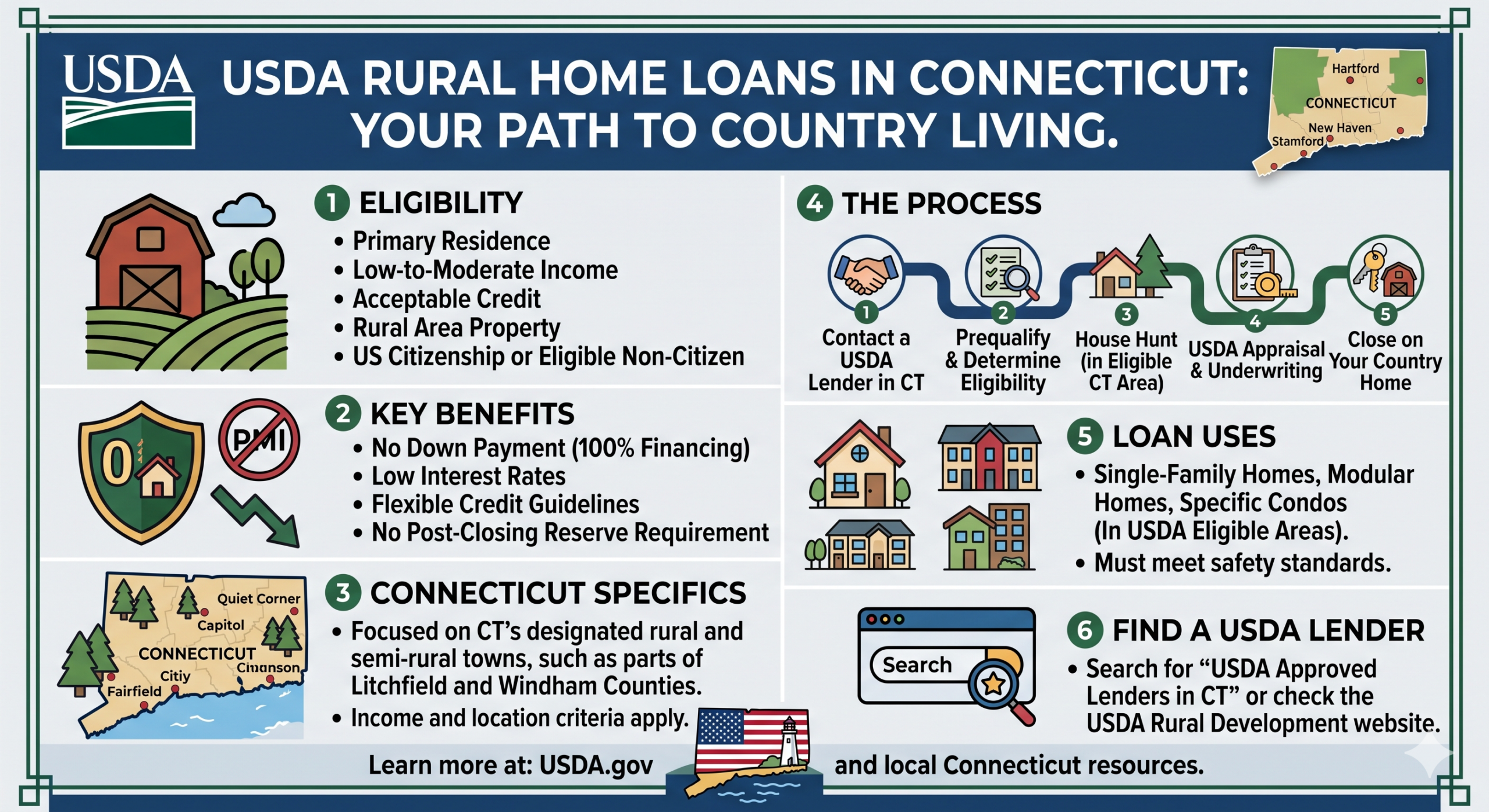
For homebuyers looking to settle outside of major urban centers in Connecticut, the USDA Rural Development Home Loan program is one of the real estate market’s best-kept secrets.
Commonly referred to as the USDA loan or Rural Housing Loan, this program is backed by the United States Department of Agriculture. While it is designed to encourage economic growth and homeownership in less dense communities, a common misconception is that you must purchase a working farm or live in a remote wilderness to qualify.
In reality, the USDA program is a highly competitive, mainstream mortgage vehicle. For qualified low-to-moderate-income families in the Nutmeg State, it provides a rare combination of 0% down payment financing and highly flexible underwriting metrics.
Navigating the program requires exploring its dual-gate eligibility matrix, understanding its local income caps, reviewing property standards, and identifying where the state’s geographic boundaries lie.
1. The Core Architecture of USDA Financing
The USDA Single-Family Housing Program is split into two primary paths, each targeting different segments of the market. While both focus on expanding homeownership, they differ significantly in how they are funded and managed.
USDA Single-Family Housing Program
  │
  ├── 502 Guaranteed Loan Program
  │     └── Issued by private lenders, backed by USDA (Most common)
  │
  └── 502 Direct Loan Program
        └── Funded directly by the government for low-to-very-low incomes
The 502 Guaranteed Loan Program
The vast majority of homebuyers utilize the Section 502 Guaranteed Loan. Under this system, you do not apply directly to the government. Instead, you work with an approved private mortgage bank, credit union, or online lender.
The private lender provides the capital, and the USDA guarantees 90% of the loan amount against default. This federal safety net allows the private lender to waive down payment requirements completely and offer interest rates that are typically lower than standard conventional mortgages. This option is designed for moderate-income households.
The 502 Direct Loan Program
The Section 502 Direct Loan is funded directly by the federal government without a private intermediary. This path is strictly reserved for applicants classified as having “low” or “very low” income (generally earning below 80% of the Area Median Income).
Direct loans feature lengthier processing timelines but provide deep structural subsidies. These can include interest rates tailored to financial need and loan terms extending up to 38 years to ensure monthly payments remain affordable.
2. The Dual-Gate Eligibility Structure
Unlike conventional mortgages, which focus almost entirely on the borrower’s personal financial strength, or FHA loans, which evaluate personal finances alongside broad safety standards, USDA loans enforce a strict dual-gate eligibility framework. To secure an approval, both the borrower’s household income and the physical property address must meet specific criteria.
Gate 1: Household Income Limitations
To ensure its resources target working families who need them most, the USDA caps the maximum amount a household can earn. A key aspect of this rule is that the USDA evaluates the total income of everyone living in the home, not just the individual whose name appears on the formal mortgage note.
If a spouse applies for the loan individually using only their income to qualify, but their partner and an adult child work and live in the home, their combined earnings must still fall under the regional USDA cap.
Because Connecticut features a high cost of living and strong median incomes, the state’s USDA income caps are structured generously compared to national baselines. The standard baseline income limit across most rural and suburban Connecticut towns sits at $137,000 for a 1-to-4 person household and scales up to $180,850 for a 5-to-8 person household.
However, in higher-cost metropolitan exception zones, these caps increase significantly:
| Connecticut Region / Exception Zone | 1–4 Person Household Cap | 5–8 Person Household Cap |
| Standard Baseline Connecticut (Most rural towns & New London/Norwich MSA) | $137,000 | $180,850 |
| Bristol, Union, Burlington, & Hartland Tier | $140,100 | $184,950 |
| Mid-Tier Towns (Bridgewater, New Milford, Lyme, Old Lyme) | $143,400 | $189,300 |
| Hartford-West Hartford-East Hartford MSA | $145,600 | $192,200 |
| Shoreline Town Tier (e.g., Old Saybrook, Clinton, Essex, Westbrook) | $149,800 | $197,750 |
| Bridgeport-Stamford-Danbury MSA | $155,050 | $204,700 |
| High-Cost Fairfield County Towns (Darien, Greenwich, New Canaan, Westport) | $176,150 | $232,550 |
Income Deductions: The USDA allows specific deductions to help households meet these limits, such as documented childcare expenses for children under 12, medical expenses for elderly dependents, or a standard $480 deduction per dependent child or full-time student.
Gate 2: Geographic Location Restrictions
The second gate mandates that the property must be located within a USDA-designated rural area. The agency defines “rural” using a combination of population density, geographical isolation, and access to traditional mortgage credit. Generally, a community must have a population under 20,000 to qualify, though some historical exemptions permit populations up to 35,000 in specific suburban pockets.
While Connecticut is a compact, densely settled state, a surprising amount of its geography qualifies for USDA financing:
-
Ineligible Zones: The entire core Interstate 95 corridor running through Fairfield and New Haven counties is excluded. Major municipal centers and their dense immediate suburbs—including Bridgeport, Stamford, New Haven, Waterbury, Hartford, New Britain, and New London—are completely ineligible.
-
Eligible Zones: Once you move outside these urban centers, whole swaths of the state open up. Nearly the entirety of Litchfield County (Northwest Hills), Windham County, and Tolland County are USDA-eligible. Substantial portions of Middlesex County, northern Hartford County (towns like Granby or Suffield), and the interior sections of New London County (towns like Lebanon, Colchester, or Griswold) qualify for 100% financing.
3. Financial Mechanics and Fee Structures
The main draw of a USDA loan is its 0% down payment requirement, allowing buyers to finance 100% of the home’s purchase price. However, borrowers should understand how the program’s fee structure impacts their overall costs.
Upfront Guarantee Fee
Because the USDA does not charge traditional private mortgage insurance (PMI), it sustains its insurance fund using a dual-fee system. The first layer is the Upfront Guarantee Fee, set at 1.00% of the total loan amount.
Like FHA and VA upfront fees, buyers rarely pay this out of pocket at closing. The USDA allows this fee to be rolled directly into the principal balance of the mortgage.
For example, if you purchase an eligible home in Woodstock for $300,000 using 100% financing:
-
Base Loan Amount: $300,000
-
Upfront Fee (1.00%):
-
Total Financed Loan Balance: $303,000
Your ongoing interest charges and monthly principal calculations will be based on this adjusted balance of $303,000.
Annual Fee (Monthly Insurance)
The second layer is the Annual Fee, which stands at 0.35% of the remaining principal balance. This fee is recalculated every year based on the outstanding loan balance, divided by 12, and added directly to your monthly mortgage statement.
On a loan balance of $300,000, a 0.35% annual fee translates to $1,050 a year, adding $87.50 per month to your total housing bill.
-
The Competitive Advantage: To put this in perspective, an FHA loan carries a monthly mortgage insurance premium of 0.55%, and conventional loans with low down payments can easily see PMI rates ranging from 0.50% to over 1.00%. The USDA’s 0.35% rate makes it one of the most affordable ongoing monthly mortgage insurance options available.
-
The Lifespan Rule: Similar to FHA guidelines, the USDA monthly annual fee remains active for the entire life of the 30-year mortgage note. It does not drop off automatically when you hit 20% equity. The only way to eliminate the fee down the road is to refinance the property into a conventional loan once your equity supports it.
4. Financial Underwriting Guidelines
While the USDA aims to expand homeownership opportunities, it still requires proof of financial responsibility and stability before issuing a loan guarantee.
Credit Score Thresholds
-
The 640 Benchmark: The USDA uses an automated underwriting platform called the GUS (Guaranteed Underwriting System). If an applicant has a credit score of 640 or higher, the platform can issue an automated approval. This streamlined process focuses primarily on validating income and employment history.
-
Manual Underwriting (Scores 580–639): It is possible to secure a USDA loan with a credit score down to 580, but the application must undergo manual underwriting. A human underwriter will carefully review your entire credit history, requiring strong compensating factors—such as a spotless 12-month rental payment history, minimal debt obligations, or substantial cash reserves—to clear the file for approval.
Debt-to-Income (DTI) Ratios
The USDA applies standard debt-to-income limits that are typically tighter than FHA or conventional alternatives:
-
Front-End DTI (Housing Ratio): Capped at 29% of your gross monthly income.
-
Back-End DTI (Total Debt Ratio): Capped at 41% of your gross monthly income, covering housing plus all recurring liabilities like student loans, auto loans, and credit cards.
However, these limits are not set in stone. If your credit score is above 640 and the GUS system detects strong compensating factors, it will routinely issue approvals for back-end DTI ratios reaching up to 45% or higher.
5. Property Condition and Appraisal Standards
When you purchase a property using a USDA loan, the appraiser must determine its fair market value while verifying that the home meets HUD’s baseline safety and soundness guidelines. Because many USDA-eligible properties in Connecticut are located in historic or semi-rural areas, certain structural features require close attention during the appraisal process.
Well and Septic Requirements
Since homes in rural communities often lack connections to municipal water and sewer lines, private wells and septic tanks are common. The USDA enforces strict rules regarding these systems:
-
Water Safety Testing: The appraiser or an independent laboratory must test the well water to confirm it meets local health standards and is free from harmful bacteria, lead, or chemical runoff.
-
Distance Specifications: The physical well head must be located away from potential contamination sources. Under standard guidelines, the well should be at least 50 feet from a septic tank and 100 feet from a septic tank drain field.
General Property Inspections
The underlying real estate must be in structurally sound, turnkey condition. Common issues that can stall a USDA loan approval in Connecticut include:
-
Lead Paint Hazards: In homes built before 1978, any peeling, chipping, or cracking paint on the exterior or interior must be scraped, primed, and repainted to prevent lead exposure risks.
-
Roofing Longevity: The roof must be completely free of leaks and have at least two years of remaining useful life.
-
Operational Mechanicals: The electrical panel, plumbing infrastructure, and heating systems must be fully functional and safe.
6. Closing Costs and Strategic Financial Adjustments
While a USDA loan requires 0% down, buyers must still account for closing costs (including property taxes, title insurance, and lender fees), which typically range from 2% to 5% of the purchase price.
Fortunately, the USDA offers unique flexibility for managing these upfront expenses, making it possible to achieve homeownership with minimal out-of-pocket cash.
Strategy 1: Capitalizing Excess Appraisal Value
If the independent appraisal notes that the home is worth more than the agreed purchase price, the USDA allows you to roll your closing costs directly into the mortgage balance, up to the maximum appraised value.
For example, if you negotiate a purchase contract for $250,000, but the formal appraisal values the home at $256,000:
-
You have $6,000 in available equity room.
-
If your actual closing costs equal $5,000, you can add that entire amount to your loan balance.
-
Your final mortgage amount becomes $255,000, allowing you to close the deal with $0 down and $0 out-of-pocket for closing fees.
Strategy 2: Leveraging Seller Concessions
The USDA allows the seller to contribute up to 6% of the purchase price toward the buyer’s closing costs. If you structure your purchase agreement carefully, your real estate agent can request that the seller pay your title fees, escrow setup costs, and origination charges at closing, reducing your financial burden on closing day.
7. Comparative Framework: USDA vs. Conventional, FHA, and VA
| Feature | USDA Loan | Conventional Loan | FHA Loan | VA Loan |
| Down Payment | 0% | 3% to 5% standard | 3.5% | 0% |
| Monthly Insurance | 0.35% (Lasts life of loan) | Scales with credit (Can be cancelled) | 0.55% (Lasts life of loan) | None |
| Location Restraints | Strictly Rural/Suburban | Anywhere | Anywhere | Anywhere |
| Income Caps | Strict regional limits | None | None | None |
8. Step-by-Step Guide to the Connecticut USDA Purchase Process
Navigating a USDA purchase involves specific administrative milestones to ensure compliance with both private lenders and government offices.
Final Takeaway
The USDA Rural Development loan is an exceptional financing option for buyers willing to look beyond Connecticut’s major urban centers. By providing a combination of 0% down financing, low interest rates, and affordable monthly fees, it offers a clear and accessible path to homeownership for moderate-income families.
While the program requires careful attention to income limits, location boundaries, and specific property conditions, the long-term savings make it an incredibly rewarding option. If you are planning to purchase a home in one of Connecticut’s many eligible suburban or rural towns, partnering with an experienced lender to leverage the USDA program can help you build long-term financial stability and equity.