Scaling Up With Multi-Families: From Small Rentals to Multi-Million Dollar Multifamily Deals
Investing in multi-million dollar multifamily deals might seem daunting, but it’s not as out of reach as you think. Many believe you need a massive inheritance or Wall Street backing to play in the big leagues of commercial real estate.
In reality, the path to large-scale syndications often starts with a single, modest property.
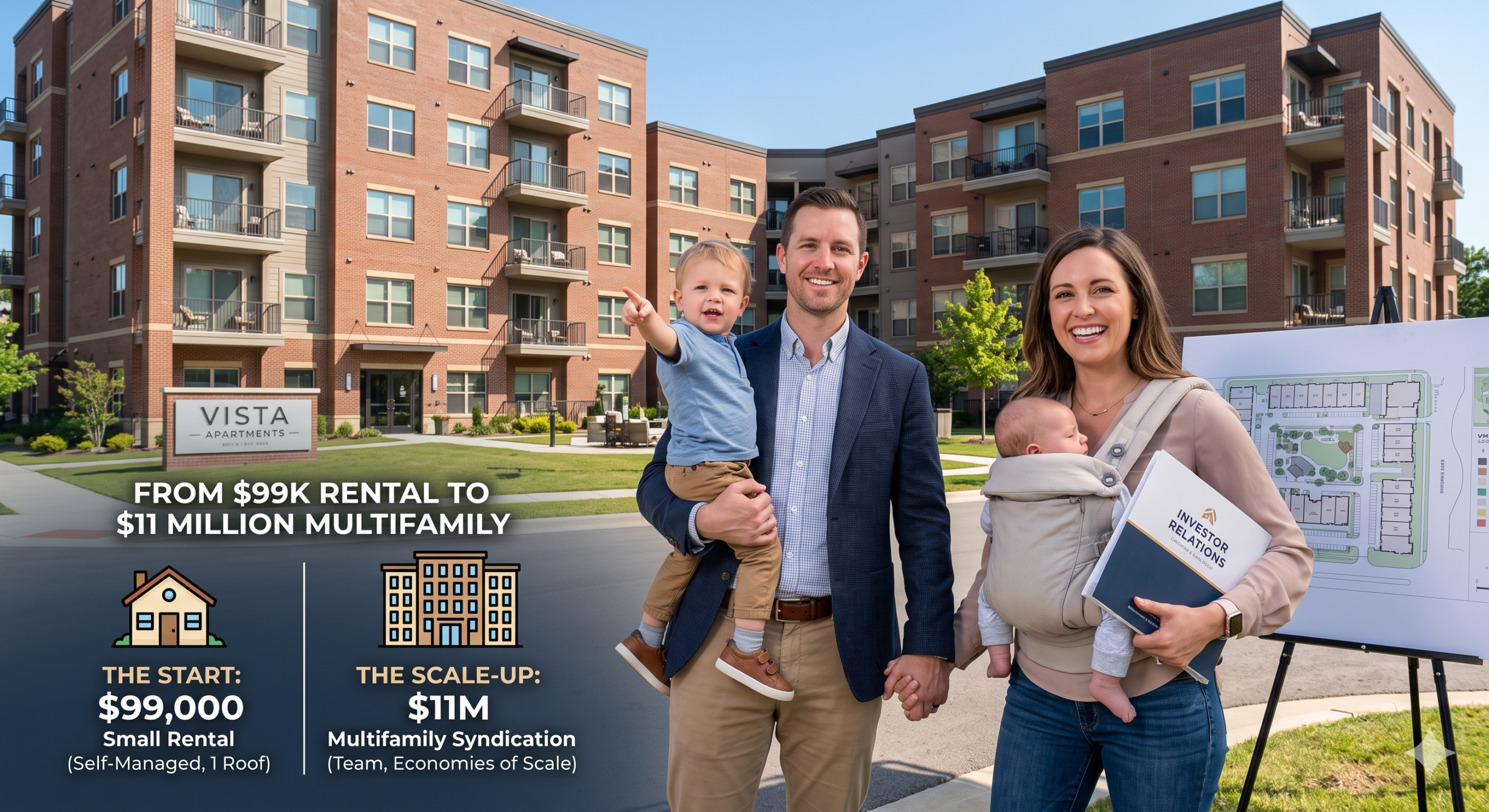
In this post, we’ll dive into the inspiring journey of two everyday real estate investors who transitioned from purchasing $99,000 single-family rentals to successfully closing an $11 million, 100+ unit multifamily apartment complex—all while managing the chaotic, rewarding demands of raising young children.
Here are the exact strategies, shifts in mindset, and insights they used to scale up in a competitive real estate market.
1. The Starting Line: The $99k Learning Curve
Every real estate mogul starts somewhere. For this couple, it was a modest $99,000 rental property.
While small properties don’t generate massive wealth overnight, they serve a critical purpose: education. Buying that first small rental teaches you the fundamentals of:
-
Analyzing cash flow and market data.
-
Dealing with property management and maintenance.
-
Understanding landlord-tenant laws.
The Realization: After a few years, they noticed a problem. Managing five separate single-family homes meant dealing with five different roofs, five separate insurance policies, and five individual loans. If one tenant moved out, that specific property was 100% vacant. They realized that to achieve true financial freedom, they needed to scale—and fast.
2. Changing the Scale, Not the Math
The biggest hurdle to jumping from a $99,000 property to an $11 million apartment complex isn’t the money—it’s the mindset.
They quickly learned that commercial real estate is actually easier to scale than residential property for three key reasons:
The Multifamily Advantage
-
Valuation based on Revenue: While single-family homes rely on “comps” (what the neighbor’s house sold for), multifamily properties are valued based on the income they generate. If you increase rent or decrease expenses, you instantly force appreciation.
-
Economies of Scale: It is vastly more efficient to manage 100 units under one single roof than 100 single-family homes scattered across a city. One property manager, one landscaping contract, and one main roof.
-
Mitigated Vacancy Risk: If a tenant leaves a single-family home, your cash flow drops to zero. If five tenants leave a 100-unit apartment building, you are still 95% occupied and fully operational.
3. The Power of Syndication (O.P.M.)
You might be wondering: How does someone go from a $99,000 budget to an $11 million purchase price?
The answer is Real Estate Syndication—essentially, crowdfunding for commercial property. They didn’t write an $11 million check themselves. Instead, they acted as the General Partners (GPs), finding the deal, securing the commercial loan, and managing the asset.
They then raised the down payment from Limited Partners (LPs)—passive investors who wanted to put their money into real estate without the hassle of being a landlord.
| Single-Family Investing | Multifamily Syndication |
| Uses personal credit and savings | Uses agency debt (Fannie Mae/Freddie Mac) and investor capital |
| Solitary and time-consuming | Team sport (Underwriters, Attorneys, Property Managers) |
| Linear growth (1 property at a time) | Exponential growth (100+ units at a time) |
4. Juggling Diapers and Deals
Perhaps the most impressive part of their journey is that they scaled this empire while raising young children. Many people use family as an excuse not to take risks, but this couple used their family as their “Why.”
To make it work, they established strict boundaries and leveraged automation:
-
Outsourcing Immediately: They didn’t swing hammers or collect rent themselves. They hired professional, third-party property management companies, allowing them to focus on finding new deals.
-
Strict Division of Labor: One partner focused on underwriting deals and talking to brokers, while the other focused on investor relations and marketing.
-
Nap-Time Hustle: Millions of dollars in real estate can be analyzed and negotiated during nap times, early mornings, and after the kids go to bed.
Case Study: From Nutmeg State To Multifamily Mogul
Abstract
This case study explores the journey of a fictitious Connecticut investor, “David,” who transforms a small $99,000 single-family rental (SFR) portfolio into a substantial $11 million multifamily asset holding. This transition highlights a deliberate shift in investment strategy, a focus on capital compounding, and the leverage of economies of scale. By analyzing David’s trajectory, this study illustrates how a methodical approach, calculated risk-taking, and strategic asset allocation can dramatically accelerate wealth creation in real estate.
1. The Starting Line: The Learning Curve and the First 99k
Like many investors, David’s foray into real estate began modestly. Working a corporate job in Hartford, CT, he desired a tangible asset that could provide passive income and long-term appreciation. His initial approach was conservative. He focused on small, accessible properties.
His first purchase was a small duplex in a reliable neighborhood in Manchester, CT. The purchase price, a figure that would prove pivotal in his narrative, was precisely $99,000. David viewed this as his “learning lab.“
-
1.1 The Manchester Duplex: The Fundamentals of Landlording
-
David used a conventional mortgage with 20% down ($19,800), plus closing costs, leveraging his personal savings.
-
The property was stable, but the cash flow was modest. His analysis taught him crucial lessons in cash flow management, maintenance costs, and understanding local tenant laws.
-
The Realization: While manageable, owning and self-managing just one small rental did not feel scalable. If one tenant moved out, his income on that unit dropped by 50% (and for the whole property, by 100% until re-rented). The logistical overhead of a single small asset was disproportionately high.
-
-
1.2 The Growing Portfolio: Replicating a Non-Scalable Model
-
Over the next few years, using forced savings and a small bonus, David purchased two more single-family rentals (SFRs)—one in New Britain and another in East Hartford.
-
By 2018, his small portfolio was worth roughly $450,000 with about $150,000 in combined equity. He was grossing about $4,500 in monthly rent, but after mortgages, insurance, taxes, and repairs, his net cash flow was less than $1,000 per month.
-
The Problem Identified: David was running himself ragged managing three scattered, disparate properties. He realized he had built a second job, not a scaling wealth engine. The administrative, maintenance, and insurance costs were not optimized. He had reached a ceiling with single-family investing if he wanted to grow significant wealth.
-
2. The Strategic Shift: Changing the Scale, Not the Math
David knew he needed a paradigm shift. He was tired of managing three separate properties, three roofs, and three distinct customer relations. His research pointed towards commercial multifamily real estate—specifically, scaling from a few doors to dozens, and eventually, hundreds. The transition was a shift in mindset as much as mathematics.
-
2.1 The Philosophy of Multifamily Advantages
-
Valuation Based on Revenue: Unlike SFRs, which rely heavily on comparable sales (“comps”) that can be volatile, commercial properties (generally 5 units or more) are valued primarily on their Net Operating Income (NOI). If an investor increases income or decreases expenses, they force appreciation, regardless of market sentiment.
-
Economies of Scale: David recognized the inefficiency of his scattered SFRs. If he owned a 50-unit building, it would have one roof, one landscaping contract, and one centralized property management point.
-
Mitigated Vacancy Risk: Losing one tenant in his Manchester duplex meant a 50% income reduction on that unit. Losing five tenants in a 100-unit building would still mean 95% occupancy, minimizing financial disruption.
-
-
2.2 Preparation for the Leap: Liquidity and Leverage
-
David decided to liquidate his SFR portfolio. He engaged a local Connecticut broker specializing in residential income properties.
-
1031 Exchange: Critically, David utilized a Section 1031 Tax-Deferred Exchange. Instead of paying capital gains on the appreciated value of his properties ($450,000 valuation, approx. $150,000 in calculated equity), he rolled the equity forward, tax-deferred, into his next large asset purchase. This kept an additional $40,000+ of investment capital working for him.
-
3. Scaling Through Strategic Acquisition and Asset Types
David’s next phase was characterized by increasing risk, complex financing, and the use of other people’s money (OPM) through syndication.
-
3.1 Step 1: The Transition Deal – The 22-Unit Complex
-
The Opportunity: David identified a well-maintained 22-unit apartment complex in Waterbury, CT, for $1.8 million. It was underperforming due to passive, owner-management (a common value-add opportunity).
-
The Plan: Leverage the $150,000 equity from the 1031 exchange as part of a 25% down payment ($450,000). He raised the remaining $300,000 from a small group of six “friends and family” investors.
-
Value-Add Play: The business plan involved light renovation (flooring, paint, modern lighting), increasing average rent from $800 to $1,000 over 18 months, and professionalizing the operations.
-
Results: Within 2.5 years, David and his management team successfully executed the plan. The property’s increased NOI allowed for a successful cash-out refinance at a 6.5% cap rate, valuing the building at roughly $2.9 million. This allowed David and his investors to pull most of their initial capital back while still controlling the asset.
-
-
3.2 Step 2: Going Institutional – The $11 Million Syndication
-
With a proven track record, David was now playing in the commercial leagues. He looked towards larger, institutionally-sized assets outside of Connecticut to a high-growth market, North Carolina.
-
The Deal: An $11 million, 102-unit apartment complex near Charlotte.
-
The Power of Syndication (The OPM Strategy): This was the inflection point. David, now positioned as the General Partner (GP), could not write an $11 million check. Instead, he structured a formal real estate syndication.
-
Capital Stack:
-
He secured a commercial, non-recourse agency loan (e.g., Fannie Mae/Freddie Mac) for 75% of the value ($8.25 million).
-
This left a $2.75 million down payment/closing cost/capital reserve equity requirement.
-
David invested $100,000 of his own capital (from his past portfolio equity and profits).
-
The remaining $2.65 million was raised from 28 high-net-worth individual Limited Partners (LPs), who sought passive real estate exposure.
-
-
Structure: As the GP, David’s team would earn fees (acquisition, asset management) and a share of the profits (a “promoted interest”) once investors received their preferred return.
-
4. The Operational Phase: Execution and Value Realization
David’s journey to $11 million was not just about acquisition; it required diligent operations on the large-scale asset.
-
4.1 Management Oversight and Institutionalization
-
David never self-managed the 102-unit complex. Instead, he hired a highly professional, third-party management company specializing in assets of that size in the Charlotte market. This decision was critical for operational scaling.
-
The Business Plan (Force Appreciation): David implemented strategies that were difficult with SFRs:
-
Value-Add Renovations: Strategic interior upgrades (cabinets, lighting, flooring) allowed for significant rent premiums of $175+ per unit.
-
Water Conservation: Installing low-flow fixtures across 102 units drastically reduced utility costs, increasing NOI.
-
Improved Collections: Modernizing the lease administration and digital payment systems reduced bad debt.
-
-
-
4.2 Leveraging Time and Automation
-
Unlike the days of his scattered SFRs, David was now focused purely on asset management (overseeing the property manager, managing investor relations, and guiding the overall financial strategy).
-
Automation: Using dedicated software for investor portals and communication allowed him to manage 28 passive investors efficiently.
-
The Family Balance: This operational structure allowed David to balance scaling his multi-million dollar business while also being present for his young family. This wasn’t achievable with his early SFR portfolio.
-
5. Synthesis and Conclusion
The journey from a single $99,000 Manchester, CT duplex to a sophisticated $11 million real estate holding is a compelling narrative of strategic evolution. By dissecting David’s trajectory, several key principles for accelerated real estate wealth creation emerge.
First, early “learning labs” are essential, but investors must avoid the trap of mistaking a heavy workload for a scalable business. David recognized that continuing to accumulate scattered SFRs was building a job, not a dynamic wealth engine.
Second, the pivot to multifamily commercial real estate was driven by the inherent advantages of commercial valuation—specifically, the ability to control value by controlling income and expenses (NOI). This shift prioritized operational optimization over simple asset acquisition.
Third, the scale was only possible by moving from solitary investing to a team sport (syndication). By utilizing Agency debt and raising the bulk of the equity from Limited Partners (OPM), David was able to command $11 million in assets using only a fraction of his own capital.
Ultimately, this case study proves that the leap from a five-figure beginning to an eight-figure portfolio is not a result of luck, but a meticulous application of finance, strategy, courage, and leverage. By shifting his focus from buying properties to buying businesses, this Connecticut investor successfully transformed his financial legacy.
Conclusion: Your Next Step
The leap from small rentals to multi-million dollar deals isn’t a matter of luck; it’s a matter of strategy and courage. By shifting their focus from buying houses to buying businesses (which is what a large apartment complex truly is), this couple transformed their financial future while building a legacy for their children.
If you are currently sitting on a few small rentals, or even if you are looking for your very first deal, stop asking yourself if you can afford an apartment building. Instead, start asking: “Who do I need to partner with to buy one?”
Are you ready to scale your real estate portfolio this year? Let us know your biggest roadblock in the comments below!