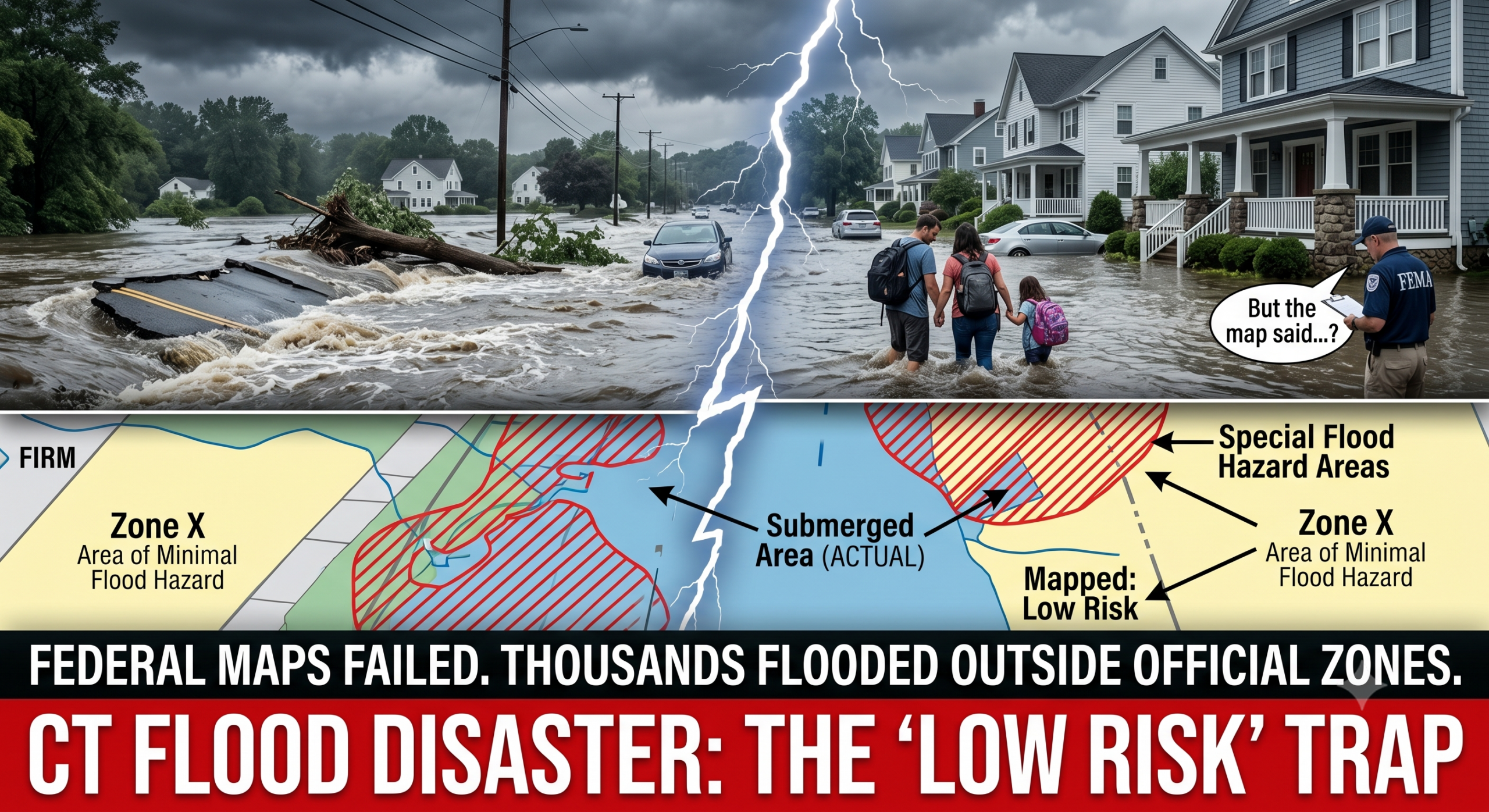
 The devastating flash flooding that tore through southwest and western Connecticut—obliterating roads, swallowing cars, and destroying properties in towns like Oxford, Southbury, Monroe, Newtown, and Seymour—revealed a hidden, financially catastrophic reality for Connecticut property owners.
Many of the homes that suffered total structural losses were classified by federal maps as “low risk,” sitting completely outside of designated special flood hazard areas.
A recent WFSB I-Team investigative report confirmed the nightmare: federal flood maps are failing to keep pace with intense, localized infrastructure-straining storms. For unsuspecting buyers and long-term homeowners, relying strictly on a government map to measure real-world property risk has become a dangerous gamble.
The Insurance Trap: Why “Low Risk” Can Mean Total Financial Ruin
When buying a home in Connecticut, if the property sits outside a federally designated high-risk flood zone, mortgage lenders do not require flood insurance.
As a result, thousands of CT homeowners carry standard homeowner’s insurance policies—which cover exactly zero dollars of rising groundwater or overland flash flood damage. When outdated municipal drainage systems, overwhelmed culverts, or buckling retaining walls cause sudden inland flash flooding, these property owners are left entirely on their own to pay for hundreds of thousands of dollars in structural stabilization, mold remediation, and rebuilding costs.
🛑 Before You Buy or Sell: Check the Official Data Closely
While federal maps are proving to have blind spots, you must always start with the official baselines. Use these verified regulatory platforms to look up your property’s official historical standings:
Verify Your Address: Search the official federal database using the FEMA Flood Map Service Center to pull your specific neighborhood’s current Flood Insurance Rate Map (FIRM).
Track National Flood Data: Learn more about changing premiums, coverage limits, and coastal realities directly from the National Flood Insurance Program (NFIP) at FloodSmart.gov.
Review CT Recovery Standards: Check the state’s historical recovery framework and damage reporting criteria at the CT.gov Division of Emergency Management and Homeland Security.
Beyond the Map: 3 Structural Risks Only an Expert Eye Catches
At Connecticut Real Estate Brokerage LLC, our 45-year foundation in custom home construction, deep structural renovations, and environmental site design means we don’t just look at a color-coded map. We look at the actual physics of the land.
When evaluating a Connecticut home for real-world water risk, look for these three critical factors that FEMA completely ignores:
1. Civil Infrastructure & Culvert Capacity
A home can sit high on a hill, but if the municipal culverts or neighborhood storm drains at the bottom of the driveway are sized for 1980s weather patterns, water will back build rapidly. During severe rain events, choked civil infrastructure acts as an artificial dam, turning quiet suburban streets into raging rivers in less than 30 minutes.
2. Topography, Saturated Soils, and Bedrock Ledges
Connecticut’s geography is unique. Much of our terrain features shallow topsoil over dense glacial till or solid granite bedrock ledges. When heavy rain hits already saturated ground, the water cannot absorb into the earth. Instead, it moves horizontally across the bedrock, pooling directly against subterranean foundation walls, punching through basement windows, and causing severe hydrostatic pressure cracks.
3. Retaining Wall Integrity & Mechanical Positioning
Older properties often rely on stacked-stone or timber retaining walls to divert natural water runoff. If these walls are bowing, un-weeped, or degrading, a sudden surge of water can trigger a complete slope failure. Furthermore, look at where the home’s mechanical systems sit. If the electrical panels, hybrid water heaters, or ductwork are placed directly on a basement floor rather than elevated, even minor localized flash flooding can instantly render a home structurally uninhabitable.
🔍 Don’t Rely on an Outdated Map. Protect Your Investment.
Whether you are looking to purchase a beautiful waterfront estate along the Connecticut shoreline, an investment property near our river valleys, or a quiet suburban home, you need to know the true structural risk before you sign a contract or risk your equity.
Get a real, construction-minded assessment of a property’s drainage, grading, and structural layout. 💬 Text “RISK” to (860) 880-0597 right now to connect directly with the team at Connecticut Real Estate Brokerage LLC. We will review your target property, evaluate the local land mechanics, and help ensure you aren’t walking blindly into an uninsured financial trap.
🛠️ Deep Dive: The Ultimate Connecticut Property Risk & Flood Resource Guide
To help Connecticut land buyers, real estate investors, and homeowners navigate the shifting landscape of environmental risks, we have compiled the definitive technical baseline for evaluating CT property. Use these resources to audit any parcel before submitting an offer.
1. Connecticut County-by-County Major Watershed Risks
Flooding in Connecticut isn’t just a coastal problem. Our inland river valleys carry significant hydrological velocity during extreme rain events:
-
Fairfield County & New Haven County: Heavily impacted by coastal storm surges along the Long Island Sound, but increasingly vulnerable to sudden flash-overland flooding from the Housatonic River, Naugatuck River, and small tributaries like the Mill River.
-
Litchfield County & Hartford County: High risk of rapid elevation runoff. The Farmington River and Connecticut River basins feature vast floodplains that can change drastically based on upstream dam releases and saturated mountain soils.
-
Middlesex County & New London County: Subject to compound flooding—where high tides meet heavy downriver freshwater surges simultaneously.
2. Understanding FEMA Flood Zone Codes in CT
When reviewing a property’s listing details or land survey, you will encounter specific federal risk codes. Here is what they actually mean for your wallet:
| Flood Zone Code | Risk Level | Mortgage Requirement | Real-World CT Meaning |
| Zone V / VE | Highest (Coastal) | Mandatory Insurance | Direct coastal areas subject to velocity (wave action). Strict building codes require homes to be elevated on pilings. |
| Zone A / AE | High (Inland) | Mandatory Insurance | Base Flood Elevations (BFEs) are determined here. Subject to 100-year river or stream overflows. |
| Zone X (Shaded) / Zone B | Moderate | Optional (But Recommended) | Areas between the 100-year and 500-year flood limits. Often where catastrophic un-mapped flash flooding occurs. |
| Zone X (Unshaded) / Zone C | Minimal | Not Required by Lenders | Classified as outside the floodplain. However, as recent events proved, poor local stormwater drainage can still flood these homes. |
3. The 4 Mandatory Environmental Audits for CT Land Buyers
If you are purchasing raw land, building a custom home, or planning a subdivision “first cut” in Connecticut, a FEMA map is only 10% of your homework. You must complete these four site steps:
-
Inland Wetlands Delineation: Connecticut protects wetlands aggressively. You must hire a Certified Soil Scientist to walk the property, test soil composition, and flag the exact boundaries. Local town setbacks from flagged wetlands typically range from 50 to 100 feet, which can severely shrink your buildable footprint.
-
CT ECO Interactive GIS Mapping: Use the Connecticut Environmental Conditions Online (CT ECO) tool to overlay historical soil data, aquifer protection zones, and critical habitats before spending money on engineering plans.
-
Deep Pit & Perc Testing: For rural areas dependent on private septic systems (common throughout Litchfield and rural New Haven counties), poor soil absorption or hitting solid granite bedrock ledge can easily add $20,000 to $40,000 in engineered septic system costs.
-
Municipal Drainage & Catch Basin Audit: Review the town’s civil engineering logs for local road culverts near the property. If the local municipality hasn’t upsized the infrastructure to handle modern storm frequencies, the property’s driveway or low-lying areas risk becoming a natural drainage channel for public road runoff.
📥 Real Estate Risk Case Studies & Consultations
Navigating Connecticut land use regulations, structural engineering requirements, and shifting coastal zone management rules requires expert oversight.
If you are currently looking at a property listing and want an experienced builder’s eye to analyze the site mechanics, bedrock realities, or potential drainage pitfalls before you lose your deposit, reach out to Steve Schappert and the team at Connecticut Real Estate Brokerage LLC.
-
Office Line: (860) 880-0597
-
Main Hub: ConnecticutRealEstate.online