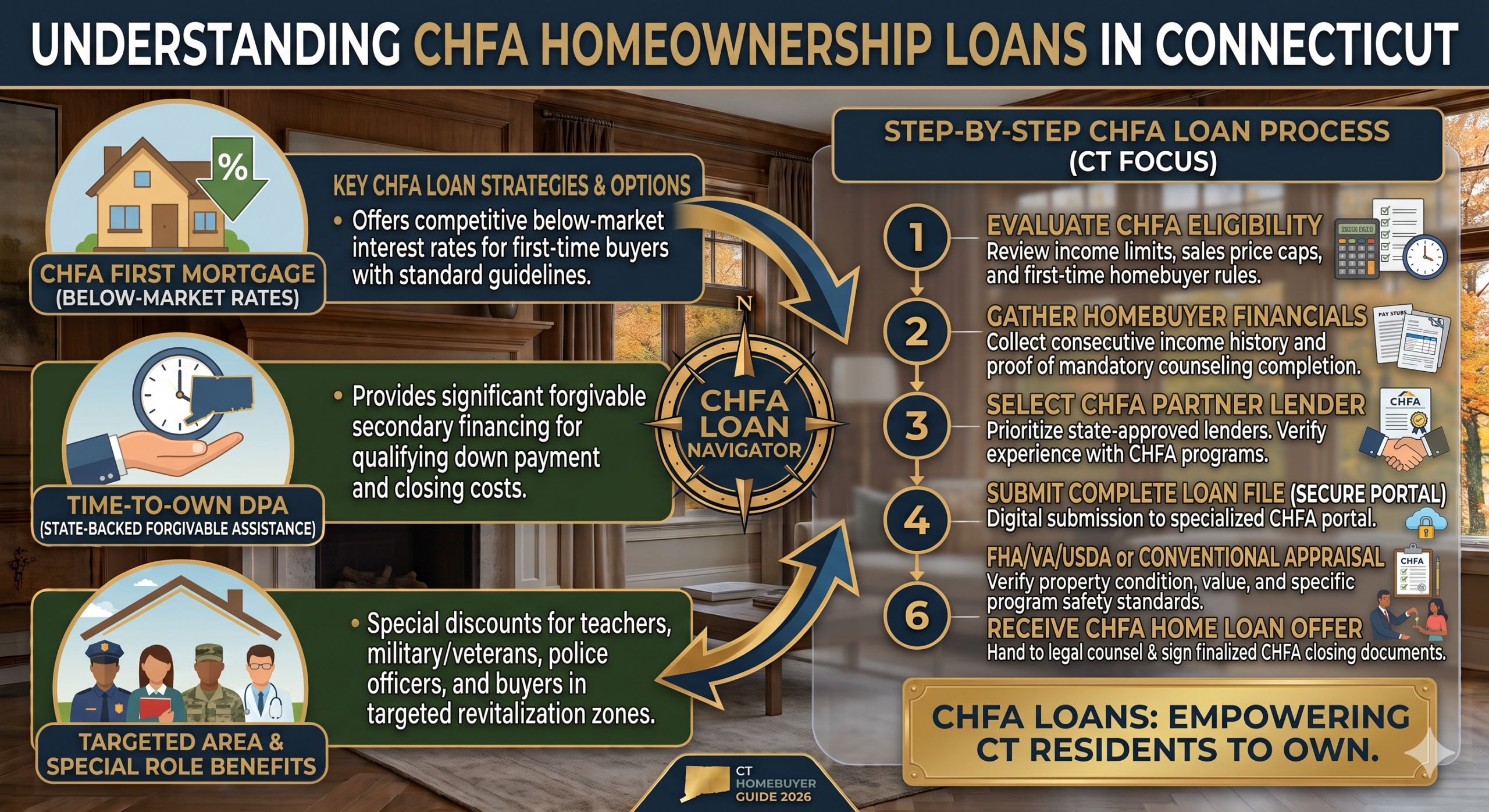
 For homebuyers looking to navigate the competitive and historically high-cost real estate market in Connecticut, the Connecticut Housing Finance Authority (CHFA) provides some of the most powerful financial solutions in the country.
Established by the state legislature in 1969, CHFA is a self-supporting, quasi-public housing agency. Its core mission is to alleviate the financial barriers to homeownership for low-to-moderate-income individuals and families across the state’s 169 municipalities.
By issuing tax-exempt housing bonds, CHFA generates capital to fund specialized mortgages featuring below-market interest rates, low down payment requirements, and highly flexible underwriting metrics. Furthermore, CHFA features an advanced ecosystem of down payment and closing cost assistance programs—such as the highly sought-after Time to Own forgivable loan—allowing qualified residents to cross the homeownership finish line with minimal out-of-pocket savings.
Call William Lavigne on his cell for the fastest service: 860-585-6285
connecticut1@gmail.com
1. The Core Architecture of CHFA First Mortgages
CHFA operates not as a direct point-of-sale lender, but as a secondary master-servicer and program administrator. To access a CHFA loan, an applicant works directly with a CHFA-Participating Lender—which includes local credit unions, regional commercial banks, and established mortgage companies across the state.
When a lender originates a mortgage under CHFA rules, the loan is bundled with an underlying primary loan framework (such as a conventional conforming product, or a government-backed FHA, VA, or USDA wrapper) and enhanced by CHFA’s low-interest rate structures.
Standard Entry Requirements
While standard conventional mortgages protect themselves by demanding premier credit tiers, CHFA programs operate with an accessible baseline:
-
The 620 Credit Baseline: To unlock CHFA’s first mortgage programs, an applicant requires a minimum credit score of 620.
-
The Low Down Payment Grid: Borrowers utilizing a conventional CHFA program need only a 3% down payment. Those pairing CHFA with an FHA vehicle require a 3.5% down payment, while VA and USDA-blended paths retain their baseline 0% down payment structures.
-
Maximum Loan Balance: CHFA aligns its maximum purchasing capacity with major federal underwriting caps. The maximum loan limit is capped at the lower of $832,750 or the statutory caps required by the specific underlying loan type (FHA/Conventional).
2. The Dual-Gate Eligibility System: Income & Purchase Price Limits
Because CHFA programs leverage state-subsidized bond capital, they enforce strict compliance checks. To maintain equity, the program utilizes a dual-gate checkpoint framework: Household Income Caps and Property Purchase Price Limits.
Gate 1: Geographic Income Caps
Unlike standard mortgages that look exclusively at the qualifying income of the individual borrower signing the note, CHFA programs evaluate the total gross annual income of everyone expected to reside in the home.
CHFA calculates its income boundaries using the regional Area Median Income (AMI). Because Connecticut’s economy transitions sharply between urban centers, industrial corridors, and affluent suburbs, CHFA organizes its income limits according to the state’s nine planning regions:
2026 CHFA Area Median Income (AMI) Baselines
  │
  ├── Western Connecticut & Greater Bridgeport Regions: $156,800
  ├── Capitol (Hartford) & Lower CT River Valley Regions: $129,200
  ├── Northeastern Connecticut Region: $126,500
  ├── Northwest Hills Region: $124,500
  ├── South Central Connecticut (New Haven) Region: $123,200
  └── Southeastern Connecticut Region: $111,900
For CHFA’s most widely utilized baseline programs, the standard statewide qualifying income limit scales safely up to $178,920 for moderate-income households, ensuring broad access across various professions.
Gate 2: Purchase Price Ceilings
To prevent state funding from subsidizing luxury speculative real estate, CHFA caps the total purchase price of the home. These caps fluctuate depending on whether the home is located in a standard territory or a State-Designated Targeted Area (neighborhoods or towns targeted for focused economic development and homeownership stabilization).
In standard non-targeted towns, purchase caps typically range from $500,000 to over $700,000, while targeted communities feature significantly higher boundaries alongside a major program perk: If you buy a home within a Targeted Area, CHFA waives the first-time homebuyer requirement entirely.
3. The Down Payment Assistance Program (DAP) Ecosystem
The primary barrier to homeownership in Connecticut is rarely the monthly payment itself; it is the upfront cash required to clear closing costs and down payment mandates. CHFA bridges this gap using two distinct secondary financing options.
The Standard Down Payment Assistance Program (DAP)
The standard CHFA DAP loan acts as a low-interest second mortgage that runs concurrently with your CHFA first mortgage.
-
The Capital Reach: DAP loans can provide up to $25,000 to cover the entire required down payment or a substantial portion of local closing fees.
-
Repayment Terms: The loan interest rate is tied directly to the rate on your CHFA first mortgage, amortizing over a matched 30-year term to ensure predictable, low monthly payments.
The Time to Own Program: Forgivable DPA
The Time to Own program is a high-impact, state-funded initiative designed to provide substantial down payment and closing cost assistance to low-to-moderate-income families.
-
The Forgivable Capital Inject: The program delivers up to $25,000 structured as a 0% interest second mortgage with no monthly payments required.
-
The Forgiveness Schedule: The principal balance of the loan is automatically forgiven at a rate of 10% annually on each anniversary of the loan closing. By the tenth anniversary, the entire balance drops to $0, and the lien is wiped away completely without costing the homeowner a dime.
-
Residency Rules: To secure eligibility, the applicant must be a current resident of Connecticut and prove valid state residency for the most recent three consecutive years. If the homeowner chooses to sell, transfer ownership, or refinance the property into a non-CHFA loan before the ten-year mark, the remaining unforgiven portion of the principal balance must be repaid to the state.
4. Specialized CHFA First Mortgage Programs
CHFA features a modular list of first mortgage options designed to fit specific homebuyer demographics and property archetypes.
1. HFA Preferred™ and HFA Advantage®
These are conventional lending structures backed by Fannie Mae and Freddie Mac, curated specifically for housing finance agencies.
-
The Low-Down Edge: Requires only a 3% down payment.
-
PMI Optimization: While standard conventional loans impose expensive Private Mortgage Insurance (PMI) on low down payments, CHFA conventional paths offer deeply discounted monthly PMI rates, saving buyers significant cash over traditional retail avenues.
2. The Military Homeownership Program
A specialized program designed to thank active-duty military members, veterans, and National Guard personnel for their service.
-
The Structural Rate Cut: Delivers an additional 0.125% interest rate reduction off CHFA’s already below-market baseline rate.
-
Targeted Area Stacking: If the service member purchases a home in an IRS-targeted revitalization town, the discount increases to a full 0.25% reduction, unlocking some of the lowest historical financing terms available in the market.
3. The Teachers Mortgage Assistance Program
To incentivize educators to live and invest in the communities where they teach, CHFA offers a targeted rate reduction program for certified public school teachers.
-
The Discount Matrix: Offers a baseline 0.125% rate discount.
-
Alliance District Enhancements: If the teacher accepts a position and buys a home within a state-designated Alliance School District—municipalities requiring educational support, such as Bridgeport, Hartford, Waterbury, or New Britain—the homebuyer requirement is waived, and the rate discount remains highly optimized to encourage community stabilization.
4. The Police Homeownership Program
Similar to the educational paths, this framework offers a 0.125% rate reduction for municipal and state police officers who choose to buy a primary residence directly within the specific towns they protect and patrol.
5. Architectural Quality: The CHFA Property Standard
Because CHFA coordinates with state bond boards, the physical real estate acting as collateral must satisfy specific lifestyle and safety guidelines.
Eligible Property Classifications
-
Single-Family Homes: Detached traditional residential structures.
-
Townhomes and Condominiums: Must belong to a complex approved by major underwriting registries (FHA/VA/Fannie Mae).
-
Multi-Family Homeownership (2-4 Units): CHFA permits the purchase of a duplex, triplex, or fourplex using state financing, provided the structure is at least five years old and the buyer occupies one of the individual units as their primary residence for the duration of the mortgage ownership.
-
Mobile Manufactured Homes: CHFA operates a specialized, low-interest mobile home path for single or double-wide units located in state-licensed mobile home parks.
The Home Inspection Framework
CHFA properties must undergo a complete home inspection alongside a standard appraisal. In Connecticut’s characteristically historic housing ecosystem, common property structural failures that must be remediated prior to closing include:
-
Peeling exterior or interior lead paint in structures built before 1978.
-
Roof components exhibiting under two years of viable remaining life.
-
Outdated, hazardous ungrounded electrical systems (knob-and-tube).
-
Active environmental structural damage, such as central or eastern Connecticut foundation degradation linked to pyrrhotite aggregate.
6. Comprehensive Program Comparison
To guide your real estate acquisition timeline, evaluate how CHFA’s primary baseline programs compare across standard operational checkpoints:
| Underwriting Variable | CHFA HFA Preferred | CHFA Government Insured | CHFA Time to Own (DAP) |
| Minimum Credit Score | 620 Baseline | 620 Baseline | Aligns with First Mortgage |
| Minimum Down Payment | 3.0% of purchase price | 3.5% (FHA) or 0% (VA/USDA) | $0 Out of Pocket |
| Interest Rate Structure | Below-Market Fixed Note | Below-Market Fixed Note | 0% Interest (Forgivable) |
| Mortgage Insurance | Discounted, cancelable PMI | Standard flat-rate FHA MIP | None |
| First-Time Buyer Rule | Required (Waived in Targeted Towns) | Required (Waived in Targeted Towns) | Required (Waived in Targeted Towns) |
| Mandatory Education | Yes (Online or in-person class) | Yes (Online or in-person class) | Yes (Extended class options) |
7. Step-by-Step Guide to the CHFA Home Buying Timeline
Navigating a CHFA home purchase requires executing specific structural tasks in exact chronological order to keep your financing valid.
Final Summary
CHFA loans represent a highly advanced, supportive framework designed to make homeownership affordable for buyers throughout Connecticut. By delivering below-market fixed interest rates, pairing with zero-down government programs, and offering forgiving down payment grants like Time to Own, CHFA significantly reduces the financial barriers to purchasing a home.
While the application process requires navigating specific household income caps, property standards, and mandatory educational milestones, the long-term financial benefits are unparalleled. Partnering with an experienced, CHFA-approved lender will allow you to maximize these state-subsidized benefits and establish deep financial roots in the Nutmeg State.
Call William Lavigne on his cell for the fastest service: 860-585-6285
connecticut1@gmail.com