Call William on his cell for the fastest service: 860-585-6285
connecticut1@gmail.com
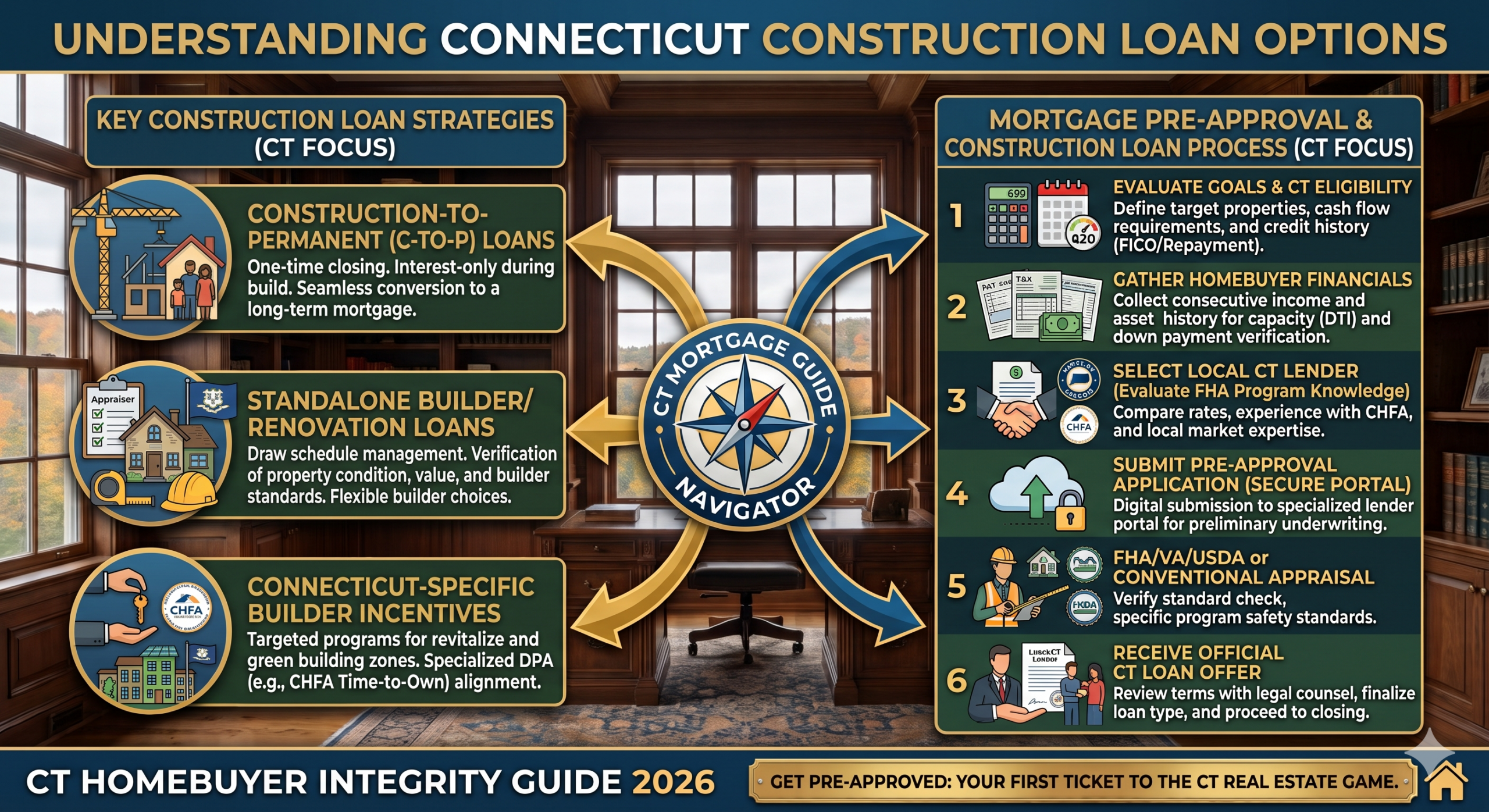
Building a custom home from the ground up or executing a complete down-to-the-studs renovation is a premier path to securing your dream property in Connecticut. However, the financial mechanics of bringing a new physical structure to life differ entirely from purchasing an existing turnkey home. When you build new, you cannot use a traditional purchase mortgage because there is no completed, verified collateral for the bank to secure against. Instead, you must utilize a specialized Construction Loan.
A Connecticut construction loan is a short-term, high-impact financing vehicle that funds the acquisition of land and the sequential stages of vertical building. Because these loans carry a high degree of operational risk—such as contractor delays, material inflation, and local zoning hurdles—lenders apply deep structural oversight.
Navigating this space successfully requires looking past simple design blue prints and mastering the lending metrics, the dual-stage closing frameworks, local municipal permitting rules, draw schedules, and state-specific legal realities like Connecticut’s closing attorney mandates and environmental parameters.
1. The Core Architecture: Construction-to-Permanent Financing
The modern mortgage market structures residential construction loans into two primary frameworks. Your choice determines your upfront closing costs, your exposure to interest rate fluctuations, and your overall administrative burden.
Construction Loan Formats
  │
  ├── One-Time Close (Single-Close)
  │     └── Blends build phase and permanent mortgage into a single transaction
  │
  └── Two-Time Close
        └── Uses two separate loans: a short-term build note and a subsequent refinancing note
The One-Time Close (Single-Close) Mortgage
The One-Time Close loan is the most widely utilized construction product. It seamlessly combines your short-term construction financing and your long-term permanent mortgage into a single legal transaction with one initial closing day.
-
The Structural Protection: You execute the paperwork and lock in your permanent 15-year or 30-year fixed interest rate before the first shovel hits the dirt. This shields you against macroeconomic shifts or spiking interest rates during the 6 to 12 months it takes to complete the physical build.
-
Cost Efficiency: Because there is only one closing transaction, you pay for title searches, lender origination charges, and local recording fees only once, saving thousands of dollars in transactional friction.
-
The Automation Drop: Once the local municipal building inspector issues an official Certificate of Occupancy (CO), the loan automatically converts from the interest-only construction phase into a standard amortizing mortgage.
The Two-Time Close Mortgage
A Two-Time Close framework treats the construction phase and the permanent phase as two completely independent real estate transactions.
-
Loan 1 (The Construction Note): A short-term, interest-only loan designed to last strictly for the duration of the building phase (typically 12 months).
-
Loan 2 (The Permanent Mortgage): Once the home is fully constructed, you apply for a brand-new permanent mortgage to pay off the balance of the initial construction note.
-
The Strategic Trade-Off: This path requires you to undergo underwriting twice, clear credit checks twice, and pay two separate sets of closing fees and closing attorney retainers. However, it offers greater flexibility. If you expect market interest rates to drop significantly during your build period, or if you need to alter the structural scope of your long-term financing near the completion date, a two-time close allows you to shop for permanent terms later.
2. The Strict Dual-Vetting Qualification Process
When you apply for a standard mortgage, the bank evaluates only one entity: you, the borrower. With a construction loan, the bank underwrites both the borrower and the general contractor. A brilliant financial profile can still be denied if your chosen builder fails the bank’s internal risk assessment.
Borrower Qualifications
Because construction projects frequently experience cost overruns, lenders apply strict financial gatekeeping metrics:
-
Credit Score Benchmarks: While standard conventional loans permit entry at a 620 credit tier, most construction programs look for a minimum credit score of 680 to 700, with elite interest tiers reserved for scores of 740 or higher.
-
The Equity Stake (Down Payment): You cannot build a custom home with zero skin in the game. Standard conventional construction programs require a minimum down payment of 10% to 20%. This equity calculation can be satisfied with cash savings or the verified equity value of the raw land if you already own the building lot.
-
Debt-to-Income (DTI) Ceilings: Lenders enforce a strict back-end DTI cap, generally restricting total recurring liabilities (including the projected permanent housing payment, taxes, and insurance) to less than 43% of your provable gross monthly income.
-
The Post-Closing Reserve Mandate: Lenders want to confirm you have cash cushions left over to manage unforeseen price spikes. Underwriters routinely require 6 to 12 months of interest payments sitting untouched in liquid accounts post-closing.
Builder/Contractor Vetting Protocols
Lenders will require your General Contractor (GC) to submit an exhaustive credential package for approval before any loan funds are authorized. The bank’s risk management team verifies:
-
Licensing Validity: The contractor must hold an active, unblemished Home Improvement Contractor (HIC) or New Home Construction Contractor license issued by the Connecticut Department of Consumer Protection.
-
Comprehensive Insurance Assets: The builder must provide proof of substantial Commercial General Liability insurance (typically a minimum of $1 million per occurrence) and valid Workers’ Compensation insurance to shield the property owner against liability if a worker is injured on site.
-
Financial Solvency and Reference Track: Lenders evaluate the GC’s corporate credit report, check for outstanding mechanics’ liens or legal judgments, and require a list of recently completed projects to verify their capacity to bring the build across the finish line.
3. The Draw Schedule and the Interest-Only Phase
Construction loans do not disburse hundreds of thousands of dollars in a single lump-sum payout at closing. Instead, the loan balance is placed into a secure escrow account and released sequentially through a structured mechanism known as a Draw Schedule.
Milestones of the Draw Schedule
The draw schedule divides the building lifecycle into 5 to 7 logical, verifiable milestones. Funds are released strictly after a phase is completed and verified by an independent inspector. A standard layout mirrors these core physical benchmarks:
Standard Construction Draw Schedule
  │
  ├── Draw 1: Site Prep & Foundation (Clearing, excavation, poured concrete)
  ├── Draw 2: Framing & Sheathing (Structural skeleton, subfloors, roof rafters)
  ├── Draw 3: Mechanical Rough-Ins (HVAC ducting, electrical wiring, plumbing lines)
  ├── Draw 4: Drywall & Insulation (Hanging, taping, insulating to code)
  └── Draw 5: Interior & Exterior Finishes (Cabinetry, flooring, trim, siding, final paint)
The Inspection Verification System
When your builder finishes a designated phase, they submit a formal draw request to the lender. The bank does not take the builder’s word for it. They dispatch a licensed independent inspector to the job site.
In Connecticut, local regional institutions—such as Torrington Savings Bank or Thomaston Savings Bank—charge a fixed fee (typically ranging from $150 to $200 per inspection occurrence) to verify the completion percentage before cutting a check to the contractor.
Interest-Only Calculations
During the active build period (usually capped at 12 months), you are not required to make full amortizing principal payments. Instead, you make monthly interest-only payments calculated strictly on the amount of funds previously disbursed, not the total authorized loan ceiling.
-
The Math: Imagine you are approved for a total construction loan of $500,000 at a 6.75% interest rate.
-
In Month 1, the builder draws only $50,000 to clear the lot and pour the foundation. Your interest payment for that month is calculated exclusively on that $50,000:
-
By Month 6, as framing and mechanicals wrap up, a total of $300,000 has been advanced. Your interest payment scales accordingly:
This variable interest escalator keeps your carrying costs manageable while your primary income is potentially still paying for rent or an existing mortgage elsewhere.
4. Local Variables: Connecticut Permitting, Mill Rates, and Legalities
Building real estate in Connecticut introduces specific geographical, regulatory, and bureaucratic layers that directly impact your construction loan underwriting timeline.
The Mandatory Attorney Closing State Law
Connecticut is legally classified as a closing attorney state. Unlike western states that use non-legal escrow entities, Connecticut requires a licensed real estate attorney to manage the mortgage execution.
For construction loans, this legal representation is even more critical. Your attorney must conduct a comprehensive title search on the underlying raw land to ensure it is free from pre-existing conservation easements, agricultural liens, or municipal zoning clouds.
They also manage the legal filing of lien waivers from subcontractors during draw cycles to prevent a plumber or lumber yard from recording a mechanics’ lien against your new home.
Municipal Autonomy and Building Permits
Connecticut features no centralized county-level government infrastructure. Instead, the state’s 169 distinct towns operate with complete municipal autonomy. Every town maintains its own unique zoning bylaws, architectural review boards, Inland Wetlands Commissions, and building departments.
-
The Permit Gate: Lenders will not authorize your construction loan to close until your builder secures a fully issued, stamped Building Permit from the local town hall. “Letters of intent to issue” are rejected.
-
Wetlands Restraints: A substantial portion of Connecticut’s geography contains protected wetlands or coastal zones. If your building lot features poorly draining soil or sits near an interior waterway, your project must clear tedious reviews by local Inland Wetlands Commissions before a permit can be processed.
The Mill Rate and Escrow Projections
As noted during your permanent mortgage analysis, Connecticut towns fund their budgets independently through localized mill rates. When budgeting a construction loan, your underwriter will look at the estimated future assessment of the completed home to project your property taxes.
If you are building a premium custom home in a high-mill territory (such as West Hartford or New Haven), your projected property taxes will drastically alter your qualifying DTI metrics compared to building that same structure in a lower-tax shoreline or rural community.
The Eastern Connecticut Foundation Crisis (Pyrrhotite Shielding)
Due to the historical contamination of residential foundations with pyrrhotite in central and eastern parts of the state, construction loan underwriters now enforce strict protocols for concrete pouring. Lenders will often require your general contractor to provide verified receipts and certified compound sheets from approved concrete aggregate facilities to guarantee that all concrete poured for your new foundation is fully documented, tested, and clear of pyrrhotite contaminants.
5. Transitioning to Permanent Financing: The Certificate of Occupancy (CO) Gate
The construction loan phase is short-term and temporary. The ultimate transition out of the interest-only phase and into a standard 15-year or 30-year amortizing mortgage is governed by a strict regulatory checkpoint: the Certificate of Occupancy (CO).
The CO Trigger
The Certificate of Occupancy is an official legal document issued by the local town building inspector confirming that the completed structure complies fully with all municipal zoning laws, state fire codes, and structural health standards. It proves the home is legally safe for human habitation.
The Reconciliation Audit
Once the CO is in hand, your lender’s internal conversion team begins a comprehensive reconciliation audit:
-
Draw Account Finalization: Every dollar disbursed throughout the project is tallied and matched against the contractor’s initial invoices.
-
The Contingency Release: Standard construction loans build in a 5% to 10% contingency budget to manage unexpected cost overruns. If your build proceeded smoothly and you did not touch this contingency cash, that unspent balance is deducted from your final principal total, reducing your permanent mortgage balance.
-
Financial Re-Verification: If your project utilized a two-time close transaction—or if your credit documents expired past standard banking limits during an extended build phase (typically over 12 to 18 months)—the underwriter will require updated pay stubs, bank statements, and a refreshed credit pull to re-verify your financial capacity before executing the permanent phase.
6. Comprehensive Structural Construction Loan Matrix
To help guide your home-building strategy, look at how the primary construction and rehabilitation loan vehicles compare across standard operational parameters:
| Operational Feature | One-Time Close Loan | Two-Time Close Loan | Fannie Mae HomeStyle® Rehab |
| Total Closings Required | One single transaction | Two independent closings | One single transaction |
| Interest Rate Management | Locked upfront before building begins | Variable build rate; permanent rate locked later | Locked upfront at application |
| Minimum Equity Profile | 10% to 20% down payment | 10% to 20% down payment | Accessible 3% down payment |
| Best Suited For | Clean custom builds with defined timelines | Volatile builds or custom interest plays | Fixer-uppers requiring structural upgrades |
| Project Target Scope | Raw land to complete vertical structure | Complex estate builds or land developments | Existing homes requiring heavy renovation |
| Closing Cost Footprint | Low to Moderate (Single fee pack) | High (Double transactional fees) | Low (Integrated purchase/rehab model) |
7. Step-by-Step Construction Loan Timeline
Bringing a custom home to life requires systematic coordination among your architect, general contractor, municipal planning boards, closing attorney, and underwriting professionals.
Final Summary
A construction loan is a powerful financial tool that allows you to bypass the constraints of existing real estate inventory and build a custom home tailored precisely to your vision. Succeeding in this highly technical space requires a clear understanding of your financing structures—whether choosing a streamlined one-time close or a flexible two-time close model—alongside careful navigation of Connecticut’s unique municipal permitting landscape and local legal rules.
By assembling an elite project team consisting of a licensed general contractor, an experienced real estate closing attorney, and a knowledgeable local lender, you can manage the structural risks of building new and successfully transition your project into a high-value, long-term asset that establishes deep roots in your chosen Connecticut community.
Call William on his cell for the fastest service: 860-585-6285
connecticut1@gmail.com