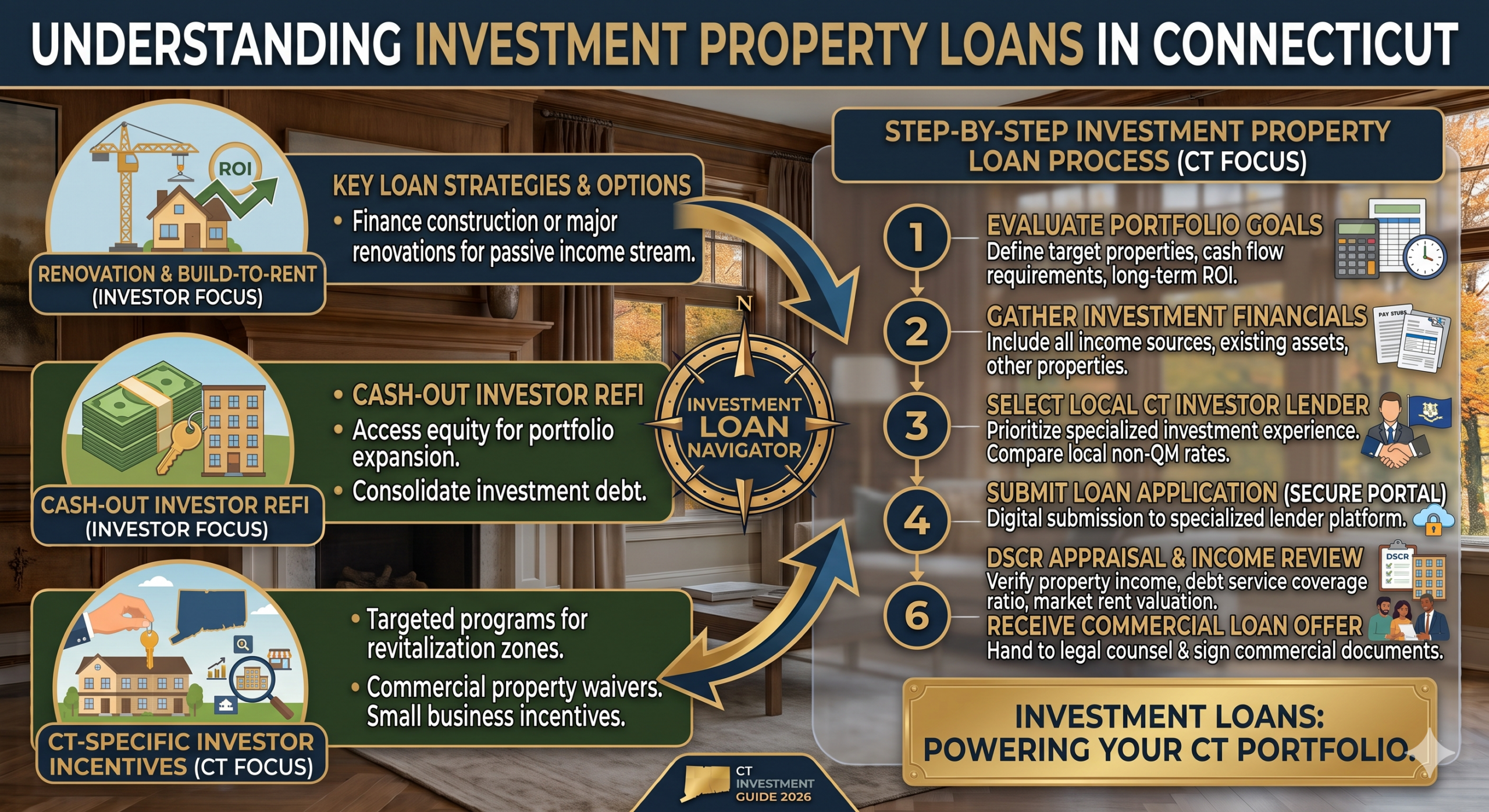
An investment property loan is a highly specialized financial instrument designed for real estate investors purchasing non-owner-occupied residential real estate to generate rental income or capture capital appreciation.
Unlike standard consumer mortgages used to purchase primary residences, investment loans carry an elevated level of risk for the issuing financial institution. Statistically, when a borrower faces severe financial distress, they are far more likely to default on a rental property mortgage than the roof over their own head.
To offset this default curve, lenders enforce much stricter qualification requirements, mandate deeper equity stakes, apply pricing premiums, and utilize highly technical rental income metrics. Understanding the structure of investment loans is essential for scaling a residential portfolio efficiently.
Call William Lavigne on his cell for the fastest service: 860-585-6285
connecticut1@gmail.com
1. The Core Risk Framework and Interest Rate Premiums
The structural baseline of an investment property mortgage is rooted entirely in risk pricing. Because the property is occupied by a third-party tenant—or potentially left vacant during turnover phases—the income stream supporting the debt is considered inherently volatile.
Mortgage Risk Hierarchy (Safest to Riskiest)
  │
  ├── Primary Residence (Lowest risk, lowest rates, lowest down payments)
  ├── Second Home / Vacation Property (Moderate risk, standard conventional terms)
  └── Investment Property (Highest risk, highest rates, maximum down payment requirements)
The 1% to 2% Interest Rate Premium
Because of this heightened default probability, lenders apply risk-based pricing adjustments. Investors should expect their interest rate to be 1% to 2% higher than the prevailing average rate for an owner-occupied conventional loan.
If prime borrowers are securing standard 30-year fixed home loans at a market average of roughly 6.50%, an investor buying an identical property next door will likely face an entry rate between 7.50% and 8.50%.
The Role of Loan-Level Price Adjustments (LLPAs)
Fannie Mae and Freddie Mac dictate baseline pricing for conventional investment mortgages using risk grids known as Loan-Level Price Adjustments (LLPAs). These adjustments function as upfront fees that are usually converted into a higher ongoing interest rate.
The penalty is calculated by cross-referencing your exact credit score with your chosen down payment percentage. For investors, these upfront risk fees can equal 2% to 4% of the total loan amount, which is why getting the best terms requires maximizing both credit health and cash down payments.
2. Rigid Underwriting Protocols: The Core Metrics
To secure a conventional investment property loan, an applicant cannot rely on thin financial profiles. Underwriters analyze four rigid pillars under a microscope.
Stricter Credit Score Baselines
While a primary home buyer can access conventional paths with a 620 credit score or FHA paths at 580, investment programs demand much cleaner history:
-
Absolute Floor: A credit score of 620 is the technical minimum for conventional investment approvals.
-
The Optimum Zone: To avoid devastating interest rate penalties driven by LLPAs, investors must present a credit score of 740 or higher. A score below 680 will dramatically increase the monthly payment, often choking out the property’s potential cash flow.
Higher Down Payment Thresholds
The down payment guidelines for non-owner-occupied real estate are firm, and private mortgage insurance (PMI) is virtually nonexistent for investment properties. Lenders bypass the risk of low-down-payment defaults by mandating that the investor hold substantial immediate equity.
-
1-Unit Single-Family Homes: Require a minimum down payment of 15% to 20%.
-
2- to 4-Unit Multi-Family Structures: Buying a duplex, triplex, or fourplex as an investment property carries higher risk. Standard conventional guidelines require a minimum down payment of 25%.
-
The LTV Sweet Spot: Most experienced investors put a full 25% down across all property types. This unlocks lower interest rate brackets and creates a wider safety margin for monthly cash flow.
Tighter Debt-to-Income (DTI) Calculations
Your personal financial health must be capable of carrying the new investment debt if the property experiences an extended vacancy. Lenders calculate your total personal liabilities alongside the new property’s full PITI payment (Principal, Interest, Taxes, and Insurance).
-
Standard Ceiling: Most investment loan programs cap the total back-end DTI at 43%.
-
Automated Override: If an investor has a credit score over 740 and substantial cash reserves, automated underwriting systems can issue approvals for DTIs reaching up to 45% or 50%, but these are handled on a case-by-case basis.
The Cash Reserve Mandate
Lenders will not allow you to exhaust your savings account to pay the down payment. Underwriters require verified, post-closing asset reserves to prove you can handle long-term maintenance issues or missing rent payments.
-
Subject Property Reserves: Typically requires 6 months of the full monthly PITI payment sitting untouched in a liquid account after closing.
-
Additional Portfolio Properties: If you own other rental properties, lenders will require an extra 2% to 6% of the remaining unpaid principal balances across your entire real estate portfolio, ensuring your entire business operation is safely capitalized.
3. Financial Mechanics: Monetizing Future Rental Income
One of the most powerful features of investment property lending is that you can use the property’s future rental income to help you qualify for the loan. Underwriters do not force your personal corporate salary to carry the entire mortgage balance alone.
The Single-Family Comparable Rent Schedule (Form 1007)
When the bank orders a standard property appraisal, they require the appraiser to complete a specialized secondary form: Fannie Mae Form 1007 (or Form 1025 for multi-unit properties).
The appraiser reviews hyper-local market data to calculate a fair, independent estimate of the home’s gross monthly rental potential.
The 75% Net Income Rule
Lenders do not credit you with 100% of that projected rental income figure. To account for future vacancies, uncollected rent, and ongoing property maintenance, the underwriter applies a standard 25% vacancy haircut. They will add only 75% of the appraised rental value to your qualifying income calculation.
-
A Real-World Math Example: Imagine you are buying a rental property with a proposed PITI payment of $2,000 per month. The appraiser completes Form 1007 and establishes that the home will easily rent for $2,800 per month.
-
The underwriter calculates your usable rental income:
-
The Underwriting Impact: Because the qualifying rental income ($2,100) exceeds the full monthly mortgage expense ($2,000), this specific property is considered self-sustaining. It adds a net $100 profit to your monthly income profile during debt-to-income underwriting, rather than acting as a liability that drains your personal income capacity.
4. Alternative Financing Paths for Real Estate Portfolios
When an investor outgrows standard conventional loans—or if their personal tax returns show heavy deductions that artificially suppress their qualifying income—they must pivot to alternative loan types.
DSCR Loans (Debt Service Coverage Ratio)
A DSCR Loan is a non-QM (Non-Qualified Mortgage) loan product designed specifically for real estate investors. DSCR loans completely ignore your personal income, tax returns, W-2 forms, and corporate job history. Instead, underwriting focuses exclusively on the cash-flow performance of the property itself.
Lenders evaluate the deal using the Debt Service Coverage Ratio formula:
-
DSCR $>$ 1.0: The property’s rental income exceeds its debt obligations, creating a positive cash flow pattern. Lenders routinely approve deals with a DSCR of 1.20 or higher with minimal friction.
-
DSCR $<$ 1.0: The rental income is lower than the mortgage payment, creating a monthly deficit. While some specialized programs will fund a deal down to a 0.75 DSCR, they will require the investor to make a larger down payment (often 30% to 35%) and pay a higher interest rate to cover the risk.
-
The Trade-Off: DSCR loans can close quickly under an LLC name and have no limit on the number of properties you can buy. However, they carry interest rates 0.50% to 1.50% higher than traditional conventional investment loans and routinely include strict prepayment penalties.
Hard Money Loans
Hard money loans are short-term, high-interest bridge options funded by private individuals or niche investment firms. They are used almost exclusively for fix-and-flip projects or the initial phase of the BRRRR strategy (Buy, Rehab, Rent, Refinance, Repeat).
-
Asset-Based Focus: Underwriting prioritizes the After-Repair Value (ARV) of the property rather than its current state or your personal income history.
-
The Cost of Speed: Hard money loans feature high interest rates (often ranging from 10% to 14%) and upfront closing fees called points (1% to 3% of the loan value). The loan terms are short, usually requiring full repayment within 6 to 12 months.
5. Comprehensive Mortgage Loan Comparison
To help guide your portfolio strategy, look at how the primary investment loan products compare across standard underwriting checkpoints:
| Underwriting Variable | Conventional Investment Loan | DSCR Investment Loan | Hard Money Bridge Loan |
| Minimum Credit Score | 620 Baseline (740+ for prime pricing) | 660 to 680 Baseline | No firm minimums (Focuses on equity) |
| Minimum Down Payment | 15% to 25% (25% for multi-family units) | 20% to 25% Standard | 10% to 20% of purchase price or ARV cost |
| Primary Income Audit | Personal W-2s, tax returns, and DTI caps | Property Cash Flow ONLY ($\ge 1.20 \text{ DSCR}$) | Property equity margins and investor experience |
| Interest Rate Pricing | Market Baseline + 1.0% to 2.0% risk premium | Market Baseline + 1.5% to 3.0% risk premium | Premium rates (10% to 14% typical) |
| Standard Loan Term | 15-Year or 30-Year Fixed Amortization | 30-Year Fixed or Interest-Only options | Short-term (6 to 12 months standard) |
| LLC Vesting Capacity | Prohibited (Must close under personal name) | Fully Allowed (Encouraged for asset protection) | Fully Allowed (Standard business entity closing) |
6. Closing Under an LLC: Asset Protection vs. Financing Flexibility
As investors grow their real estate businesses, protecting personal assets becomes a primary concern. Choosing whether to title a property in your personal name or under a Limited Liability Company (LLC) has major implications for your financing options.
The Conventional Closing Block
Traditional conventional loans backed by Fannie Mae and Freddie Mac must be closed under an individual’s personal name. The mortgage notes cannot be issued to an LLC.
If you want to use a conventional loan to capture the lowest possible interest rates, you must close personally and buy a robust umbrella insurance policy to manage your liability risks.
Alternative LLC Pathways
If closing under an LLC is a non-negotiable requirement for your legal protection strategy, you must step away from conventional lending pathways and utilize commercial or non-QM channels:
-
DSCR and Commercial Portfolio Loans: These programs allow you to close the transaction directly under an LLC name. The property title and mortgage note vest with the corporate entity.
-
The Personal Guarantee: Even when closing under an LLC, the lender will still require you to sign a personal guarantee. This legal clause states that if the corporate entity stops making mortgage payments, you remain personally liable for the outstanding debt, meaning the bank can still look at your personal assets during foreclosure collection.
7. Step-by-Step Investment Property Loan Timeline
Final Summary
Investment property loans are designed to match the unique financial mechanics of rental real estate. Achieving success as an investor requires looking past simple property search engines and mastering the underlying lending guidelines. By building an elite credit history, preparing substantial down payment capital, and selecting the right loan product—whether a conventional framework or a cash-flow-focused DSCR option—you can build a scalable, predictable real estate portfolio that secures your long-term wealth.
Call William Lavigne on his cell for the fastest service: 860-585-6285
connecticut1@gmail.com