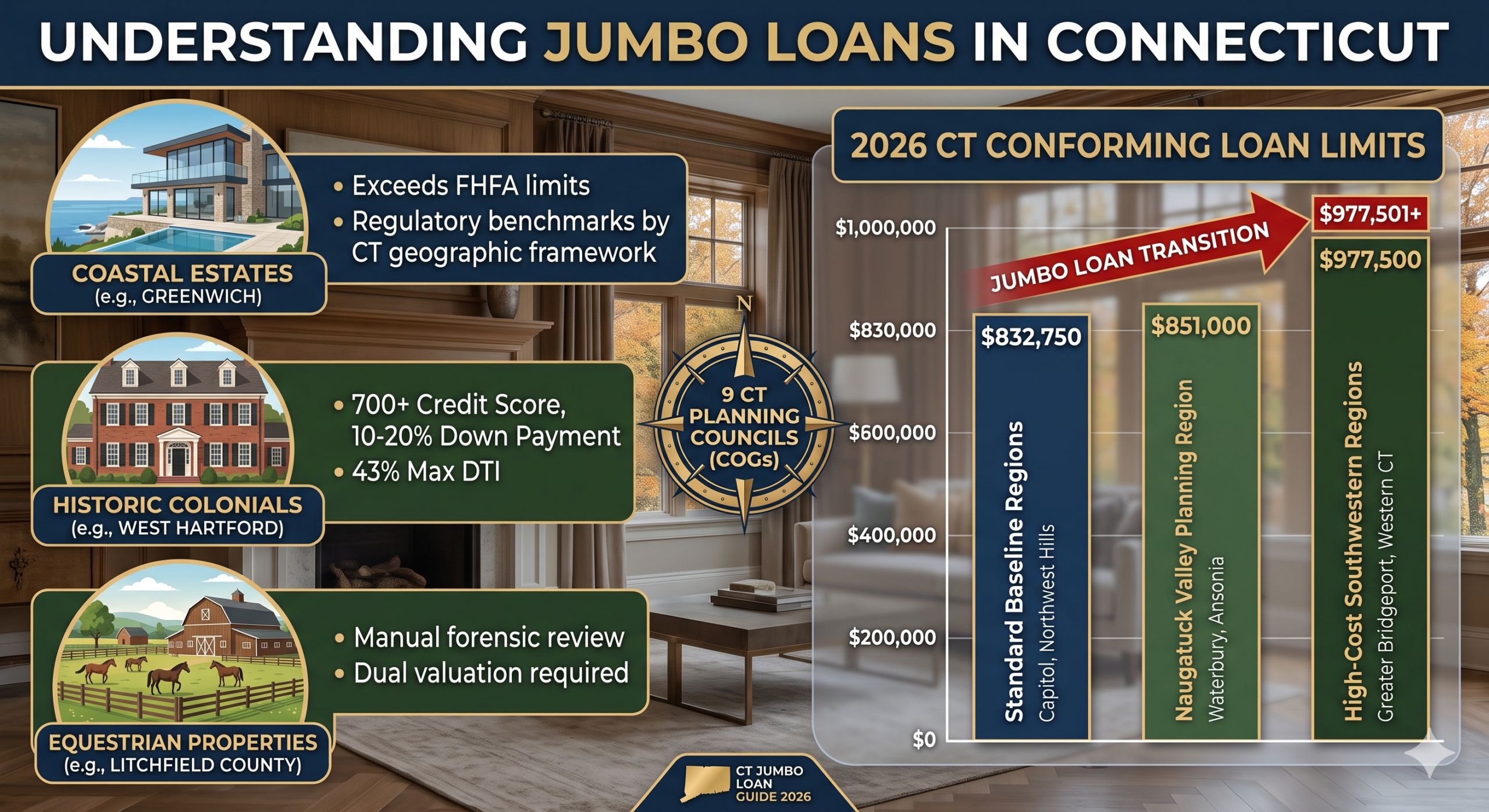
 When navigating the premium sectors of the Connecticut real estate market—whether eyeing a coastal estate in Greenwich, a historic colonial in West Hartford, or a sprawling equestrian property in Litchfield County—buyers quickly run into the boundaries of standard mortgage financing. When a home purchase requires a mortgage balance that exceeds local regulatory caps, it transitions into a Jumbo Loan.
Because these high-value loans cannot be packaged and sold to government-sponsored entities like Fannie Mae and Freddie Mac, they carry a completely different risk profile, stricter qualification standards, and unique local benchmarks dictated by Connecticut’s recently updated geographic planning framework.
1. Defining the Jumbo Frontier in Connecticut
A jumbo loan is defined not by the luxury features of a home, but by a precise mathematical threshold: it is any mortgage that exceeds the Conforming Loan Limit (CLL) set annually by the Federal Housing Finance Agency (FHFA).
The 2026 Conforming Tiers
The FHFA establishes conforming loan limits based on regional median home price inflation. Historically, these limits were mapped by county lines. However, Connecticut has fully transitioned its federal reporting to its nine regional planning councils (COGs).
If your loan balance exceeds the threshold for your specific planning region, your mortgage automatically becomes a non-conforming jumbo loan. In Connecticut, the market is divided into three distinct conforming limits:
| Connecticut Planning Region | 2026 Conforming Limit (1-Unit Baseline) | Jumbo Designation Threshold |
| Standard Baseline Regions (Capitol, Lower CT River Valley, Northeast Hills, Northwest Hills, South Central, Southeastern) | $832,750 | $832,751+ |
| Naugatuck Valley Planning Region (e.g., Waterbury, Shelton, Ansonia) | $851,000 | $851,001+ |
| High-Cost Southwestern Regions (Greater Bridgeport and Western Connecticut) | $977,500 | $977,501+ |
Why the Distinction Matters
When a mortgage fits within conforming limits (under $832,750 in Hartford or under $977,500 in Stamford), the private bank knows it can easily sell that loan to Fannie Mae or Freddie Mac. This eliminates the long-term risk for the bank and frees up cash to issue more loans.
With a jumbo loan, the lender must keep the loan on its own books (portfolio lending) or find specialized private investors. Because there is no government-backed secondary market safety net, if a borrower defaults on a $2 million mortgage in Westport, the bank absorbs the multi-million dollar loss directly. To balance this heightened exposure, lenders enforce rigid gatekeeping guidelines.
2. Strict Qualification Metrics for Jumbo Borrowers
While conventional conforming loans rely heavily on algorithmic automated underwriting systems, jumbo underwriting is a meticulous, highly manual process. Lenders verify every element of an applicant’s financial life under a microscope.
Stricter Credit Score Benchmarks
While a buyer can secure a conforming conventional loan with a credit score of 620, jumbo loans require excellent credit:
-
Absolute Minimum: Most jumbo programs require a minimum credit score of 700 to 720.
-
The Multi-Million Dollar Tier: If the requested loan amount exceeds $1.5 million or $2 million, lenders routinely look for scores of 740 or higher to secure approval.
Larger Down Payment Requirements
The days of putting down 3% or 5% do not exist in the jumbo space. Lenders require borrowers to have a meaningful financial stake in the property from day one.
-
Standard Jumbo Entry: Expect a minimum down payment of 10% to 20%. For a $1.2 million home purchase in West Hartford, a 15% down payment means preparing $180,000 in liquid cash, before accounting for closing costs.
-
Super-Jumbo Tier: For ultra-luxury properties in Fairfield County requiring loans over $2.5 million, down payment thresholds frequently escalate to 25% or 30%.
Tighter Debt-to-Income (DTI) Controls
Conforming and FHA loans frequently allow total back-end DTI ratios to reach 45% to 50% if the borrower has strong compensating factors. Jumbo loan programs draw a much firmer line:
-
The 43% Ceiling: Most jumbo lenders enforce a strict maximum back-end DTI of 43%, though many preferred portfolio programs prefer to see this metric safely below 36% to 38%.
-
The Math: If a self-employed business owner in Avon generates a provable gross monthly income of $25,000, their total monthly debt obligations (the new jumbo PITI payment, plus auto loans, credit cards, and luxury boat financing) cannot exceed $10,750 under a strict 43% ceiling rule.
The Asset Reserve Mandate
The asset reserve requirement is often what catches high-income buyers off guard. Even if you have a perfect 780 credit score and a full 20% down payment, a jumbo lender will not let you close if the transaction drains your bank accounts completely.
Lenders require post-closing liquid reserves measured in months of the total proposed mortgage payment (Principal, Interest, Taxes, and Insurance, or PITI).
-
Standard Requirement: Typically 6 to 12 months of reserves.
-
The High-Value Reality: If your new premium home payment is $8,500 per month, a 12-month reserve rule means you must prove that you have an additional $102,000 sitting untouched in liquid accounts after making your down payment and paying all closing costs.
-
Eligible Asset Types: Lenders will count 100% of liquid checking and savings accounts. They will also accept brokerage accounts, stocks, mutual funds, and retirement accounts (like 401ks or IRAs), though retirement funds are often discounted by 30% to 50% to account for potential tax penalties and market volatility.
3. Comprehensive Documentation and Income Scrutiny
Jumbo underwriting does not allow for guesswork. Lenders require comprehensive paperwork to build a bulletproof case for approval.
W-2 Executive and Corporate Compensation
For corporate executives or financial professionals working in Southwestern Connecticut’s hedge fund and corporate corridors, income structures are rarely limited to a base salary. Lenders look closely at:
-
Bonus and Commission Consistency: If a substantial portion of your qualifying income stems from annual corporate bonuses or commissions, you must document a rock-solid, two-year consecutive history of receiving those payouts from the same employer, along with proof from upper management that the compensation structure is expected to continue.
-
Restricted Stock Units (RSUs): RSUs are a standard part of executive compensation packages in premium markets. To count RSUs toward your qualifying income, you must provide the official vesting schedule, verify a two-year history of vesting, and demonstrate that additional stock is legally scheduled to vest for at least three consecutive years moving forward.
Self-Employed and Complex Business Entities
If you are an entrepreneur, partner in a law firm, or independent consultant, the underwriting timeline extends significantly. Lenders will deploy specialized forensic accountants to review:
-
Two full years of complete personal and business federal tax returns (including all schedules, K-1s, Form 1120-S, or Form 1065).
-
A certified, year-to-date Profit and Loss (P&L) statement and corporate balance sheet.
-
Business bank statements covering consecutive months to verify that the business maintains enough operational cash flow to support your personal income withdrawals without jeopardizing the entity’s health.
4. The Jumbo Appraisal Protocol
In standard conforming real estate deals, a single property appraisal confirms that the home’s market value matches the purchase price. In the jumbo segment, the valuation process is far more intense.
The Two-Appraisal Mandate
Because property valuations in the multi-million dollar tier can be highly subjective, most jumbo lenders require two independent appraisals for loan amounts exceeding $1.5 million or $2 million.
-
Both independent appraisers must evaluate the home’s square footage, build quality, and regional historic relevance.
-
The Lower Valuation Wins: If Appraiser A values a coastal home in Stamford at $2.2 million, but Appraiser B values the property at $2.1 million, the lender will base their loan-to-value calculations strictly on the lower $2.1 million figure. The buyer must then negotiate a price drop or cover the $100,000 shortfall out of pocket.
Unique Structural Challenges in Connecticut
Connecticut’s premium housing inventory introduces several distinct appraisal variables:
Premium Property Appraisal Complexities
  │
  ├── Historic and Heritage Architecture (Designated districts, unique materials)
  ├── Outbuildings & Estates (Guest cottages, detached studios, equestrian facilities)
  └── Coastal Infrastructure (Sea walls, flood mitigation, FEMA zoning compliance)
-
Historic Preservation Restrictions: Homes located in designated historic districts (like parts of Litchfield or Fairfield) feature unique building materials and preservation mandates. Appraisers must find comparable sales with similar historical designations to ensure accurate valuations.
-
Equestrian Properties and Outbuildings: High-value rural homes often include barns, guest houses, or detached studios. Appraisers must carefully separate the value of the primary living space from these specialized structures.
-
Coastal and Flood Zoning: Properties along Long Island Sound face strict FEMA flood plain regulations. Appraisers must verify the elevation certificate and assess the integrity of sea walls or structural pilings, which directly impacts the property’s insurability and underwriting risk.
5. Strategic Loan Execution: Standard vs. Relationship Portfolios
When seeking a jumbo loan, it pays to understand the different business models lenders use. This choice can impact your rate, your underwriting experience, and your approval chances.
Traditional Wholesale Retail Lenders
Standard retail mortgage companies look at jumbo loans through a rigid checklist. They look for clean, easily documentable financial profiles that fit predefined boxes. If your file meets their criteria, they offer competitive market rates, close the deal, and often transfer the servicing rights to an external entity.
Relationship Wealth Management Portfolio Banks
Many major financial institutions treat jumbo mortgages not as a standalone transaction, but as a gateway to a broader wealth management relationship.
If you are buying an expensive home, portfolio banks will often provide customized loan options if you agree to bring your investment business to them:
-
Asset Deposition Discounts: A private wealth bank may offer to slash your jumbo interest rate by 0.25% to 0.50% if you agree to move a significant sum of money (e.g., $250,000 or $500,000 in liquid assets or investments) into their custody post-closing.
-
Flexible Underwriting Guidelines: Because portfolio banks intend to hold your multi-million dollar debt on their own balance sheets for the long haul, they have the freedom to override standard rules. If your DTI ratio is slightly elevated at 45%, but you have $2 million in liquid stocks held with their firm, a portfolio underwriter can manually approve the loan based on your overall financial strength.
6. Comprehensive Mortgage Comparison
To see how jumbo loans compare to standard options, it helps to look at them side-by-side with conventional conforming and government-backed alternatives:
| Underwriting Feature | Conforming Conventional Loan | FHA Loan Option | Jumbo Mortgage Vehicle |
| Maximum Loan Balance | Capped at local limits ($832,750 to $977,500 in CT) | Strict county caps (Max $977,500 in Fairfield) | Uncapped (Lenders routinely fund up to $5M–$10M) |
| Minimum Credit Score | 620 Baseline | 580 Baseline (3.5% down) | 700 to 740 Baseline |
| Minimum Down Payment | 3% for first-time buyers; 5% standard | 3.5% Flat | 10% to 20% Standard |
| Mortgage Insurance | Required under 20% down; can be cancelled | Required for the life of the loan structure | None (Lenders avoid PMI by mandating higher down payments) |
| Underwriting Pathway | Automated via AUS platforms | Flexible manual options allowed | Meticulous manual forensic accounting |
| Post-Closing Reserves | 0 to 2 months typical | None required | 6 to 12 months of total PITI payments |
7. The Jumbo Application and Closing Process
Navigating a high-value real estate transaction requires careful planning and coordination among local professionals.
Final Summary
Jumbo loans are a vital tool for accessing Connecticut’s premium housing markets, offering the substantial capital required to purchase exceptional homes. Navigating this space successfully demands financial maturity, excellent credit health, significant down payment reserves, and impeccable record-keeping.
While the underwriting process is inherently rigorous and detailed, well-qualified buyers can secure highly competitive terms. By understanding your local regional planning limits, preparing your documentation early, and exploring private wealth portfolio options, you can confidently navigate the high-value mortgage market and protect your long-term wealth.