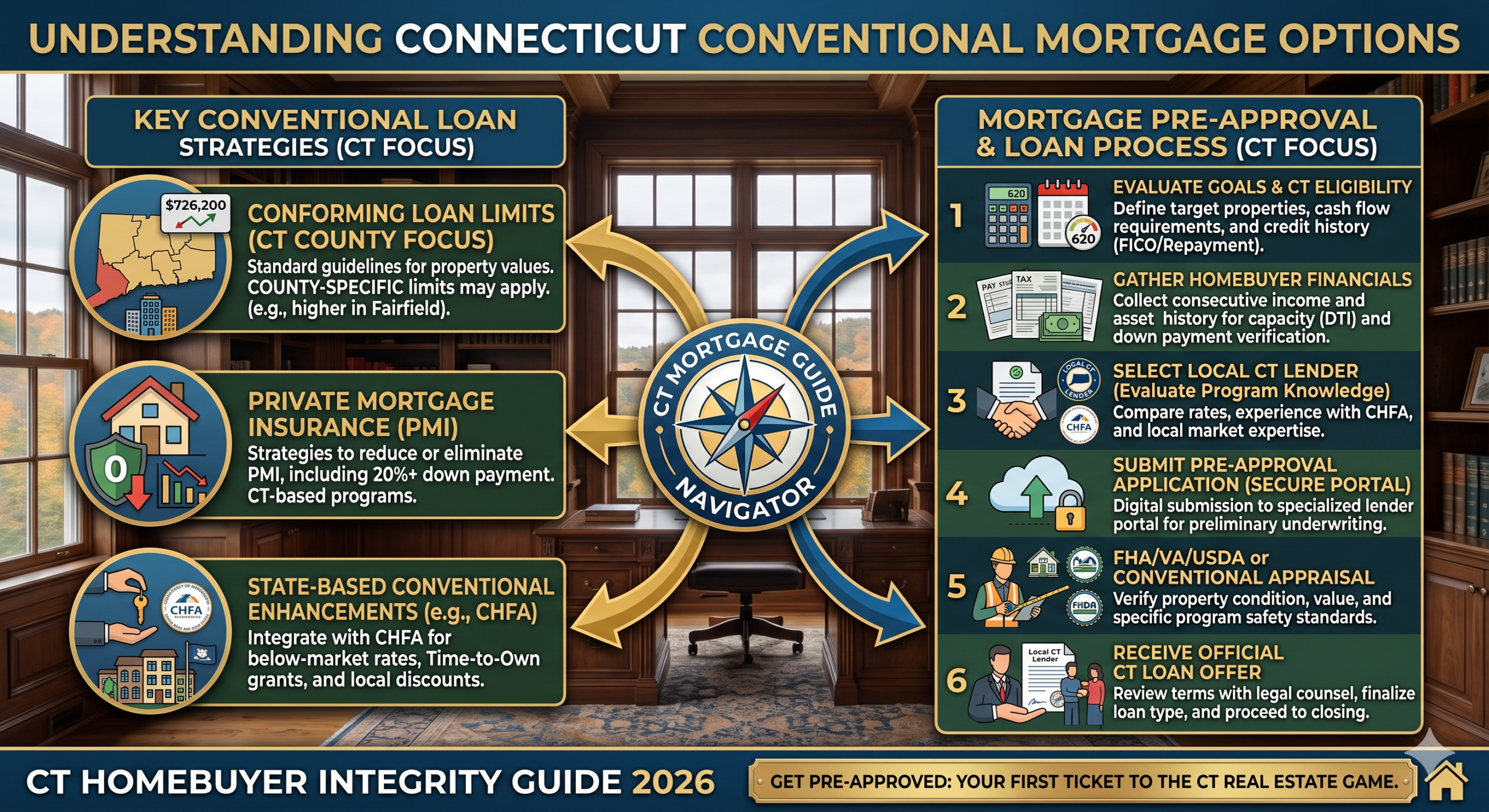
 A conventional loan is the bedrock of the American housing market. Making up roughly 70% to 80% of all residential mortgage applications, it is the standard by which all other home loans are measured.
Unlike government-backed alternatives, conventional loans are issued by private lenders (like banks, credit unions, and online mortgage companies) and are not directly guaranteed by the federal government.
Understanding conventional loans requires looking at how they work, their strict qualification boundaries, the math behind their costs, and how they stack up against other options.
Call William on his cell for the fastest service: 860-585-6285
[email protected]
1. What Exactly is a Conventional Loan?
The defining characteristic of a conventional loan is the absence of a government guarantee.
To understand why this matters, look at how the other side of the market works. When a borrower takes out an FHA loan, the Federal Housing Administration promises the lender that if the borrower defaults, the government will step in and pay back the loss. Because of this safety net, lenders can accept lower credit scores and smaller down payments.
With a conventional loan, the lender takes on the risk. If you default on your payments, the private financial institution stands to lose money. To mitigate this risk, conventional loans carry more stringent qualification requirements than government-backed loans. However, they reward well-qualified buyers with greater flexibility, lower long-term fees, and the ability to cancel costly mortgage insurance once equity is established.
The Two Pillars: Conforming vs. Non-Conforming
Conventional loans are split into two categories based on whether they meet the guidelines set by the Federal National Mortgage Association (Fannie Mae) and the Federal Home Loan Mortgage Corporation (Freddie Mac). These two government-sponsored enterprises (GSEs) buy mortgages from private lenders to keep cash flowing in the housing market.
-
Conforming Loans: These adhere strictly to the rules established by Fannie Mae and Freddie Mac. The most notable rule is the maximum loan limit, which changes annually based on national housing prices. When a loan “conforms” to these rules, the lender knows they can instantly sell the mortgage to Fannie or Freddie, freeing up capital to issue another loan. Because these loans are highly liquid and low-risk for the bank, they feature the lowest conventional interest rates.
-
Non-Conforming Loans (Jumbo Loans): If a loan violates even one of Fannie Mae or Freddie Mac’s guidelines—most commonly by exceeding the local conforming loan limit—it becomes non-conforming. Because lenders cannot easily package and sell these loans on the secondary market, they must either keep them on their own books or find niche private investors. Because of this added risk, non-conforming loans require significantly higher credit scores, larger down payments, and deeper financial reserves.
2. Core Qualification Criteria
Because private lenders bear the ultimate risk of default, the gatekeeping for conventional loans is strict. Lenders look at four pillars of financial health: credit score, debt-to-income ratio, down payment, and employment history.
Credit Score Requirements
While you can secure an FHA loan with a credit score as low as 500 (with a 10% down payment), conventional loans draw a firm line in the sand:
-
Minimum Score: 620 is the absolute baseline required by Fannie Mae and Freddie Mac.
-
The Reality of Pricing: Just because you can qualify with a 620 does not mean it will be cheap. Conventional loans use a tiered pricing system called Loan-Level Price Adjustments (LLPAs). If your credit score is between 620 and 660, you will be hit with higher interest rates and expensive private mortgage insurance premiums.
-
The Sweet Spot: To unlock the most competitive rates and lowest insurance costs, lenders typically look for a credit score of 740 or higher.
Debt-to-Income (DTI) Ratio
Your DTI ratio measures how much of your gross monthly income goes toward paying recurring debts. Lenders calculate two types of DTI:
-
Front-End DTI (Housing Ratio): The percentage of your monthly income that will go strictly toward your new housing payment (Principal, Interest, Taxes, and Insurance, or PITI). Lenders generally prefer this to stay below 28%.
-
Back-End DTI (Total Debt Ratio): The percentage of your income required to cover all monthly obligations, including housing, student loans, auto loans, credit card minimums, and child support.
For standard conventional conforming loans, the maximum allowable back-end DTI is typically 43%. However, if a borrower has “compensating factors”—such as an exceptionally high credit score or significant cash reserves—automated underwriting systems may approve DTIs up to 45% or even 50%.
Down Payment Thresholds
There is a persistent myth that conventional loans require a 20% down payment. While 20% is ideal, it is no longer the entry barrier.
-
First-Time Homebuyers: Programs like Fannie Mae’s HomeReady and Freddie Mac’s Home Possible allow down payments as low as 3% for qualifying low-to-moderate-income borrowers or first-time buyers.
-
Repeat Buyers: Standard conventional guidelines permit a minimum down payment of 5% for a primary residence.
-
The 20% Threshold: If you put down less than 20%, lenders will require you to pay Private Mortgage Insurance (PMI). Putting down a full 20% eliminates this monthly fee entirely, saving you thousands of dollars over the lifespan of the loan.
Employment and Income Verification
Lenders look for stability. They want proof that your income is reliable and likely to continue for at least three years.
-
W-2 Employees: Typically require the two most recent years of tax returns, W-2 forms, and consecutive pay stubs covering the last 30 days.
-
Self-Employed Borrowers: If you own a business, do freelance work, or operate as an independent contractor, the scrutiny intensifies. You must provide two full years of signed personal and business federal tax returns, a year-to-date profit and loss statement, and bank statements proving steady cash flow. Lenders will calculate an average income based on your net profit, not your gross revenue.
3. The Math Behind the Costs
Borrowing hundreds of thousands of dollars involves more than just a monthly mortgage payment. Conventional loans carry several distinct cost structures.
Interest Rate Structures: Fixed vs. Adjustable
When choosing a conventional loan, you must decide how your interest rate will behave over time.
Conventional Loan Options
  │
  ├── Fixed-Rate Mortgages (FRMs)
  │     └── Rate remains locked (e.g., 15-year or 30-year terms)
  │
  └── Adjustable-Rate Mortgages (ARMs)
        └── Rate adjusts periodically after an initial fixed period (e.g., 5/1 or 7/1 ARMs)
-
Fixed-Rate Mortgages (FRMs): The interest rate is locked in for the entire life of the loan—whether that is 10, 15, 20, or 30 years. Your monthly principal and interest payment will never change. This offers complete predictability and shields you against rising market interest rates.
-
Adjustable-Rate Mortgages (ARMs): These loans offer a lower, introductory interest rate for an initial period (typically 5, 7, or 10 years). Once that period ends, the rate adjusts annually based on a market index (like the Secured Overnight Financing Rate, or SOFR). If interest rates spike, your monthly payment can jump significantly. ARMs are best suited for buyers who plan to sell or refinance before the initial fixed period ends.
Private Mortgage Insurance (PMI)
If you put down less than 20% on a conventional loan, the lender forces you to pay for PMI. This insurance policy protects the lender—not you—in case you stop making payments.
PMI is calculated as a percentage of your total loan amount, usually ranging from 0.2% to 1.5% annually. The exact cost depends on your credit score and the size of your down payment. For example, on a $400,000 loan with a 1% annual PMI premium, you will pay an extra $4,000 a year, broken down into $333.33 added directly to your monthly mortgage bill.
Unlike FHA mortgage insurance, which stays on the loan for its entire life, conventional PMI can be cancelled. Under the Homeowners Protection Act, you can request PMI cancellation once your loan balance drops to 80% of the home’s original value. The lender must automatically terminate it once the balance hits 78%.
Closing Costs
Closing costs are the processing fees paid to lenders and third parties to finalize the loan. For a conventional loan, closing costs typically amount to 2% to 5% of the total loan amount. On a $350,000 home, this means preparing to pay between $7,000 and $17,500 out of pocket on closing day.
These fees generally include:
-
Loan Origination Fees: What the lender charges to evaluate and process your application (typically 0.5% to 1% of the loan amount).
-
Appraisal Fee: Paid to an independent appraiser to confirm the home is worth the purchase price ($400 – $700).
-
Title Insurance and Search Fees: Protects against any competing claims or liens on the property ownership.
-
Prepaid Items: Pro-rated property taxes and homeowners insurance premiums placed into an escrow account.
4. Conventional Loans vs. Government-Backed Alternatives
To see why a conventional loan might be your best option—or why you might want to avoid it—it helps to compare it directly to its government competitors: FHA, VA, and USDA loans.
| Feature | Conventional Loan | FHA Loan | VA Loan | USDA Loan |
| Minimum Credit Score | 620 | 500 (with 10% down) or 580 (with 3.5% down) | None set by VA (lenders prefer 580-620) | 640 preferred |
| Minimum Down Payment | 3% for first-time buyers; 5% standard | 3.5% | 0% | 0% |
| Mortgage Insurance | Cancelable at 20% equity; depends on credit score | Required for life of loan (in most cases); flat rate | None (replaced by a one-time funding fee) | Required for life of loan; lower fee than FHA |
| Property Restrictions | Few restrictions (any standard, viable home) | Must meet strict health and safety guidelines | Must meet strict Minimum Property Requirements (MPRs) | Property must be in a designated rural area |
| Loan Limits | Capped by conforming limits (unless Jumbo) | Lower limits than conventional in most counties | No caps for buyers with full entitlement | No strict loan limits; subject to income caps |
Why Choose Conventional Over FHA?
FHA loans are excellent for buyers with lower credit scores or limited savings. However, if your credit score is above 680, conventional loans are almost always cheaper in the long run. FHA loans require both an upfront insurance fee (1.75% of the loan value) and a monthly premium that rarely goes away. With a conventional loan, you avoid the upfront fee, and your monthly PMI disappears once you build up equity.
Why Choose Conventional Over VA or USDA?
VA loans (for veterans and active military) and USDA loans (for rural homebuyers) offer incredible terms, including 0% down payments. However, they are highly restrictive. If you are not a veteran, you cannot get a VA loan. If you want to buy a house in a major suburban or urban center, you cannot get a USDA loan. Conventional loans can be used to buy any property, anywhere, by anyone who qualifies.
5. Property and Loan Type Flexibility
One major advantage of conventional financing is its lack of restrictions regarding property usage and loan types. Government loans are heavily focused on protecting low-to-moderate-income families purchasing primary residences. Conventional loans, on the other hand, cater to investor and lifestyle markets.
Property Classifications
-
Primary Residences: Single-family homes, townhomes, approved condominiums, and multi-family properties (up to 4 units) where the buyer intends to live full-time.
-
Second Homes / Vacation Properties: If you want to buy a beach condo or a mountain cabin for personal holiday use, conventional loans are virtually your only standard mortgage option. Government loans strictly forbid financing properties that are not your primary residence.
-
Investment Properties: Buying a house specifically to rent out for passive income or to flip for a profit requires a conventional loan. Because rental properties carry a higher default rate, lenders will require a higher down payment (usually 15% to 25%) and a strong credit score.
Specialized Conventional Structures
Beyond standard purchases, conventional loans can be tailored for specialized financial needs:
-
Fannie Mae HomeStyle Renovation: A single loan that allows you to buy a fixer-upper and finance the repairs all under one mortgage note. The loan amount is based on the estimated completed value of the home after upgrades, rather than its current state.
-
Conventional Cash-Out Refinance: Allows homeowners to replace their current mortgage with a new, larger conventional loan, pocketing the difference in cash. This cash can be used for home improvements, debt consolidation, or other financial goals, provided the homeowner maintains at least 20% equity in the property after the transaction.
6. Navigating the Loan Application Process
The path to securing a conventional loan requires careful preparation. Because underwriting is thorough, being organized can save weeks of processing time.
Step 1: Pre-Approval
Before you step foot in an open house, you should secure a pre-approval letter. This is a preliminary commitment from a lender stating exactly how much money they are willing to lend you based on an initial check of your credit score and financial documents.
A pre-approval shows real estate agents and sellers that you are a serious, qualified buyer capable of closing a deal.
Step 2: House Hunting and Sales Contract
Once you find a home within your pre-approved budget, you submit an offer. When the seller accepts, you sign a purchase agreement. This document establishes the timeline for your loan application, home inspection, and final closing.
Step 3: Formal Loan Application and Underwriting
With your signed contract in hand, your loan moves into the formal application stage. The lender submits your paperwork to an underwriter—the financial detective responsible for verifying every piece of your financial history. The underwriter ensures that your file strictly adheres to Fannie Mae, Freddie Mac, or private investor rules.
During this stage, the lender will order a property appraisal to ensure the home’s market value matches or exceeds your loan amount.
Step 4: Conditional Approval and Clear to Close
It is rare for an underwriter to approve a loan without asking for clarification. You will likely receive a conditional approval, meaning your loan is approved if you provide additional documents, such as a recent bank statement explaining a large deposit or an extra tax form.
Once those conditions are met, you receive the golden ticket of real estate: Clear to Close. This means the underwriting process is finished, the funds are approved, and your closing day is scheduled.
7. Strategic Advantages and Disadvantages
Deciding whether a conventional mortgage is right for your unique situation requires weighing the long-term trade-offs.
The Advantages
-
Long-Term Cost Savings: If you have strong credit, conventional loans offer lower overall monthly payments because their interest rates and PMI premiums are highly optimized for low-risk borrowers.
-
PMI Elimination: The ability to drop mortgage insurance without paying thousands of dollars to refinance down the line is a massive financial advantage over FHA choices.
-
Seller Preference: In competitive real estate markets, sellers often prefer buyers with conventional pre-approvals. Sellers know that conventional loans have fewer bureaucratic property inspection hurdles than FHA or VA loans, making the transaction smoother and faster.
-
No Property Boundaries: You can purchase an urban high-rise condo, a suburban investment property, or a rural estate without worrying about government location or usage restrictions.
The Disadvantages
-
Strict Access Bars: If your credit score is sitting at 600, or if you have a recent bankruptcy or foreclosure on your record, you will be locked out of conventional financing options where government loans might offer a second chance.
-
Higher Out-of-Pocket Expenses at Lower Credit Tiers: If you apply for a conventional loan with a credit score near the 620 minimum, your interest rate and monthly PMI fees will be significantly higher than if you chose an FHA loan with that same score.
-
Severe Cash Reserve Scrutiny: For investment properties, second homes, or high-value jumbo loans, conventional underwriters will often demand that you have anywhere from 2 to 12 months’ worth of mortgage payments sitting untouched in a liquid savings account after paying your down payment and closing costs.
Final Takeaway
Conventional loans are designed to reward financial stability. If you have spent time building a strong credit history, maintaining a low debt profile, and saving money for a down payment, a conventional mortgage is the most flexible, cost-efficient vehicle available to help you build home equity.
However, if you are still working on your credit profile or need a low down payment option without premier credit, exploring government-backed alternatives first can help you bridge the gap until you are ready to transition into a conventional loan via refinancing down the road.
Call William on his cell for the fastest service: 860-585-6285
[email protected]