 Connecticut’s Supply Squeeze How Plummeting New Listings Are Keeping the Market Tight in 2026
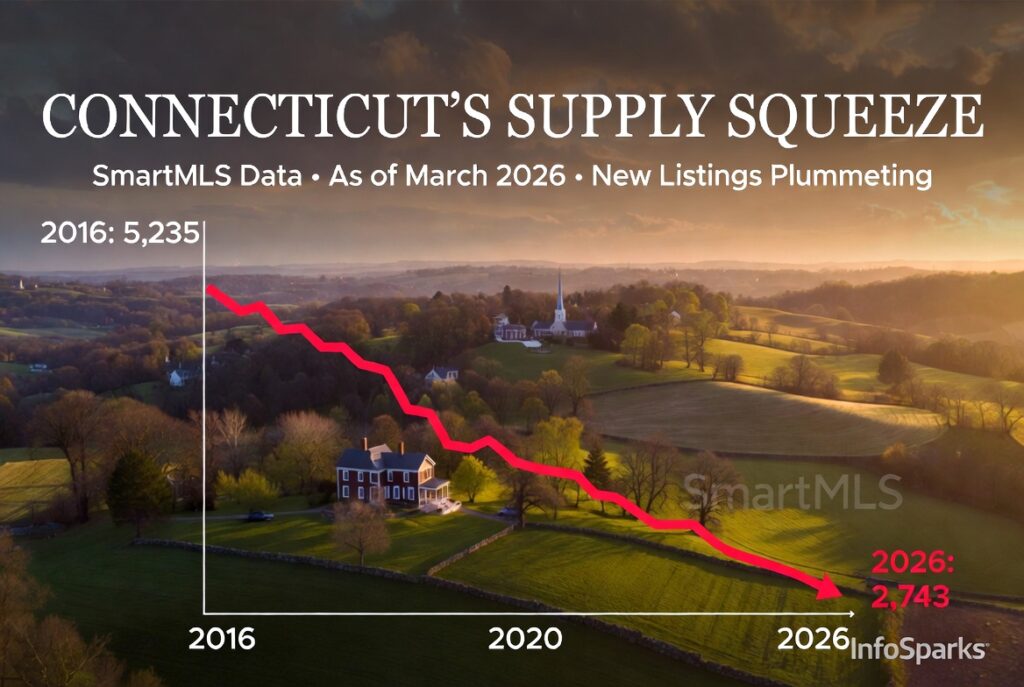
The Story in a Single Red Line From the Berkshire foothills to the Long Island Sound, a single red line on the SmartMLS dashboard reveals a stark truth few headlines are telling: new homes coming onto the market have dropped dramatically. The chart tracks new listings across the entire SmartMLS over rolling 12-month periods. In 2016 the line sat at 5,235. By March 6, 2026 it has fallen to just 2,743 — a plunge of nearly 48%. Not a temporary dip. Not seasonal noise. A sustained, stubborn decline that continues to lock up choices for buyers and prop up prices across Connecticut.
This is no abstract graph. It is the reason a young nurse in Torrington still scrolls for weeks before finding one decent colonial. It is the frustration of a retired couple in Bristol who want to downsize but see almost no fresh competition. It is the daily reality for families in New Milford who must bid aggressively on the few homes that do appear. And it is the data point Steve Schappert, the veteran Thomaston broker whose contact appears at the bottom of this exact SmartMLS dashboard, has been monitoring with growing concern.
What Are New Listings? New listings are homes that sellers have just placed on the market for the first time. The SmartMLS dashboard measures the total count of these fresh properties over rolling 12-month windows, smoothing out seasonal swings so the real trend is unmistakable. Unlike total active inventory (everything currently for sale), new listings show the fresh supply entering the market each month. Fewer new listings mean fewer choices, longer searches, and continued upward pressure on prices.
A Decade of Decline: From 5,235 in 2016 to 2,743 in 2026 “Look at the numbers,” Schappert says. “In 2016 we had 5,235 new listings rolling through the MLS. Today that figure has collapsed to 2,743 — less than half. Sellers are holding on. Baby boomers aren’t downsizing as fast as expected, pandemic buyers are staying put, and high mortgage rates have frozen many others in place. The result is the tightest supply we’ve seen in years.”
The clean professional dashboard — the same one agents embed on websites and share with clients — plots those rolling 12-month counts like a warning light for Connecticut’s housing supply. Each point captures a full year of newly listed homes from every town SmartMLS serves. The relatively healthy flow of 2016. The sharp collapse during the pandemic frenzy when nobody wanted to sell. And now this continued downward slide through 2026, even as some analysts hoped supply would finally recover.
Voices from the Ground: Real Families Feeling the Pinch In Torrington, Maria Gonzalez — the single mother who closed on her three-bedroom colonial last month — remembers the struggle. “There were so few new listings when I was looking,” she says. “Steve showed me the chart — 5,235 back in 2016 versus barely half that now. I had almost no options. I had to move fast when something decent finally appeared.”
Her story repeats across the state: the young couple in Watertown who waited eight months for a fixer-upper in Harwinton because fresh listings were so scarce; the teacher in Woodbury who missed three homes because only a handful came on the market each month; the Brooklyn transplants in New Preston who settled for a smaller lot than they wanted because the supply simply wasn’t there.
The Human Cost of Shrinking Supply The drop in new listings has real consequences. First-time buyers in Stamford and Norwalk face even longer searches and stronger competition on the few homes that do appear. Days on market remain low in many areas because whatever does list often sells quickly. Sellers who price right still move fast, but the overall lack of fresh inventory keeps the entire market feeling squeezed.
Baby boomers who planned to downsize are staying in their homes longer. Pandemic-era buyers who once thought they might relocate are now locked in by low-rate mortgages and high replacement costs. Builders, facing elevated material prices and cautious buyers, have been slow to add meaningful new construction. The result: total active inventory remains far below what buyers need.
Why New Listings Keep Falling What the chart cannot show — but daily reality confirms — is the deeper forces at work. High mortgage rates have convinced many homeowners to stay put rather than trade up or down. The lingering effects of the pandemic migration wave have left thousands of new Connecticut residents happily rooted and unwilling to list. And the state’s enduring appeal — top schools, four seasons, proximity to New York without the city price tag — keeps demand strong while supply shrinks.
Every corner of SmartMLS territory feels it: Litchfield County’s rural towns, Fairfield County’s suburbs, and the Quiet Corner are all seeing fewer fresh listings than a decade ago. The red line on the dashboard tells the same story everywhere.
Looking Ahead: Will Supply Ever Return? The future is uncertain. Analysts expect only modest national relief if rates ease later this year. Connecticut could remain one of the tighter markets in the Northeast unless more sellers decide to list. Schappert’s grounded forecast: “We’re not going back to the easy supply of 2016. Buyers have accepted that reality. The question now is how long this squeeze lasts — and how much higher prices will climb while we wait.”
For now, the red line continues its downward march. It represents missed opportunities, longer searches, and — for thousands of Connecticut families — the quiet frustration of a market that simply isn’t producing enough homes.
The Quiet Power of the Data As March 2026 unfolds, with sugar maples budding and the first robins returning from Torrington to Stonington, families are making decisions that will shape the next decade. Some are holding off on selling. Others are buying the few homes that appear. Many are simply watching the SmartMLS dashboard, hoping the numbers turn around.
The chart does not judge. It simply records.
And in that honest recording lies its power. In an age of hype and headlines, this single red line delivers unvarnished truth: supply is shrinking, not growing. The market remains tight. And Connecticut — resilient, desirable, and stubbornly short on homes — continues to be a place people desperately want to call home.
Email
Cell: 203-994-3950 Office 860-880-0597