 Litchfield County’s Quiet Climb
How Steady Home Prices Are Reshaping Lives in the Northwest Hills
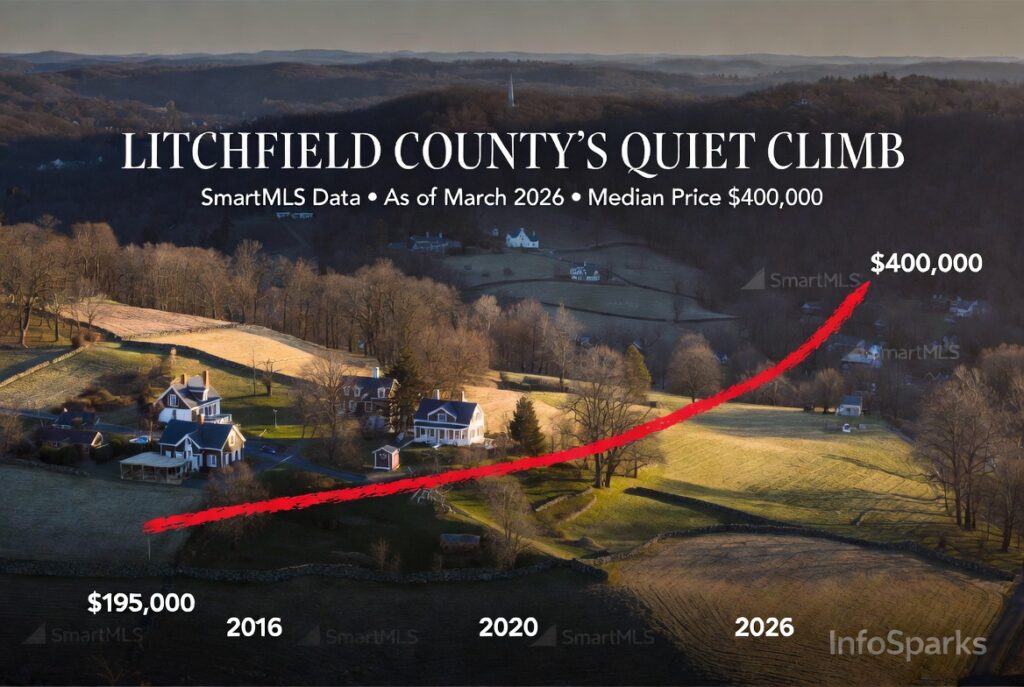
The Story in a Single Red Line In the shadow of the Berkshire foothills, where stone walls snake through pastures that have fed families since before the Revolution, a single red line on a market dashboard tells a story deeper than any national headline. It is the median sales price for homes across Litchfield County — the rural heart of northwest Connecticut — plotted over rolling 12-month periods. As of March 6, 2026, that line has settled near $400,000, up roughly 6 percent from the same point last year. Not a frenzy. Not a collapse. Just a quiet, stubborn ascent that has quietly rewritten the hopes, hardships, and horizons of people who call these hills home.
What Is Median Sales Price? The median sales price is the most honest number in real estate. Unlike an average (which can be wildly skewed by a few multimillion-dollar estates or distressed sales), the median is the exact middle point: line up every closed sale in the county from lowest to highest price, and the median is the price right in the center. Half the homes sold for more, half for less. The SmartMLS dashboard uses this rolling 12-month median so seasonal spikes and one-off luxury deals don’t distort the picture. It shows the true heartbeat of what typical families are actually paying — and right now, that heartbeat is steady and strong.
A Decade of Doubling: From $195,000 to $400,000 “Look at the numbers,” says Steve Schappert, the veteran Torrington broker whose contact sits at the bottom of the very dashboard in question. “In 2016 the county median sat at just $195,000. By early 2026 it has climbed to $400,000 — more than doubling in a decade. But what you see now isn’t panic or speculation. It’s resilience. The line keeps rising, even as mortgage rates sit above 6 percent and buyers everywhere else are hesitating.”
The dashboard itself — clean, professional, the same one agents embed on websites and share with clients — plots those rolling medians like a heartbeat monitor for the county’s economic soul. Each point captures a full year of closed sales across every town from Canaan to Bethlehem. The long, flat recovery after the Great Recession that left the 2016 median at $195,000. The sharp pandemic spike when remote workers from New York discovered they could trade Manhattan rents for Litchfield acreage. And now this measured climb through 2026: slower than the frenzy years, yet steady.
Voices from the Hills: Real Stories Behind the Numbers In Torrington, Maria Gonzalez — the single mother who closed on her colonial last month — paid $312,000 for a three-bedroom with a yard big enough for her boys to play. “Steve showed me the county chart,” she says. “Prices were climbing from that $195,000 baseline we all remember, but inventory was tight. I knew if I waited another year it would cost more. Now my kids have space to breathe instead of concrete.”
Her story echoes in every corner of the county: the young couple in Watertown who saved for four years and finally bought in Harwinton; the teacher in Woodbury who commutes to Danbury but wanted her own garden; the family relocating from Brooklyn who found in New Preston the kind of life they once only dreamed about.
The Shadows of the Climb Yet the climb casts shadows too. First-time buyers in Litchfield proper or Kent face sticker shock that once belonged only to Fairfield County. Days on market have edged up slightly — 45 days county-wide in recent months versus 38 a year ago — a sign that the white-hot competition of 2021 has cooled into something more thoughtful. Sellers who price too high sit. Buyers who lowball walk away empty-handed.
Inventory remains the quiet villain. SmartMLS listings across Litchfield County stay stubbornly low — enough to keep upward pressure on prices, yet not enough to flood the market. Baby boomers are staying put longer. Pandemic transplants have put down roots. New construction crawls along, slowed by high costs and protective zoning.
The human toll shows up daily: the young couple in Sharon who watched their dream farmhouse in Cornwall jump another $30,000 while they saved; the widow in Plymouth who sold after her husband’s long illness and walked away with enough equity to secure her grandchildren’s future — all because that steady red line never broke.
Why Litchfield County Holds Strong What the chart cannot show — but local reality reveals — is the way this climb is reshaping the county’s soul. In affluent villages like Litchfield and Washington, medians push toward $500,000, drawing weekenders who value the quiet. In working-class towns like Torrington, Thomaston, and Winsted, gains are smaller but transformative — the difference between renting forever and owning a piece of the American dream.
Litchfield County is not booming like Austin or crashing like parts of Florida. It is holding its own, proving that its blend of historic villages, working farms, world-class schools, and four distinct seasons still commands a premium. Federal Reserve rate hikes slowed the ascent but never reversed it. Pandemic migration provided a floor. The county’s diversified economy — manufacturing in Torrington, tourism around the lakes, nearby insurance and health care — insulated it from national swings.
Looking to the Horizon The future remains unwritten. Analysts expect modest national acceleration if rates ease later this year. Litchfield County could ride that wave or see its line flatten if inventory finally grows. Schappert offers a grounded forecast: “We’re not going back to 3 percent mortgages. Buyers have accepted that reality. What they haven’t accepted is this inventory drought lasting forever. When more boomers retire south and builders catch up, the climb may ease. But ease doesn’t mean decline. Not here in these hills.”
For now, the red line continues its measured march. It has added more than $205,000 to the typical Litchfield County home since 2016. That number is college funds started, retirements secured, and — for some — the difficult choice to keep renting a little longer.
The Quiet Power of the Data As March 2026 unfolds, with sugar maples beginning to bud and the first robins returning to the fields from Torrington to Salisbury, families are making choices that will echo for generations. Some are buying at the peak of this particular cycle. Others are waiting for the mythical dip that never quite arrives. The chart does not judge. It simply records.
And in that quiet recording lies its power. In an era of screaming headlines and viral panic, the Litchfield County housing story — reflected in the SmartMLS data — offers something rarer: truth without drama. A red line that rises not because of bubbles or hype, but because these hills, stubborn and beautiful and enduring, remain a place people still fight to call home.

Email
Cell: 203-994-3950 Office 860-880-0597