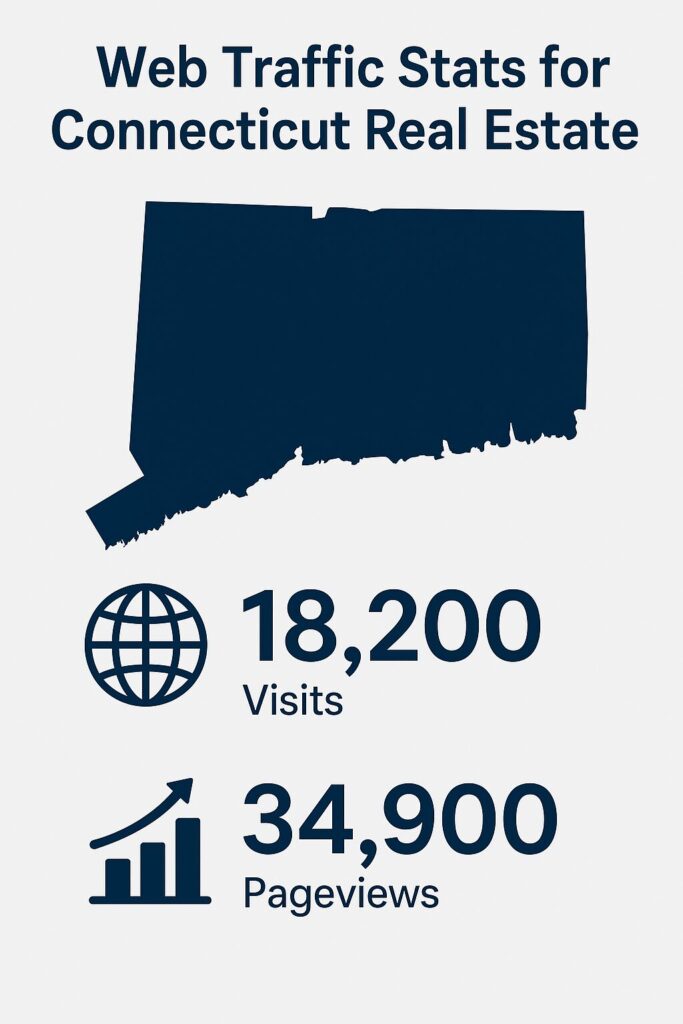
Web traffic Stats for Connecticut Real Estate
1. Macro digital-demand indicators for Connecticut real estate
While comprehensive statewide web-traffic data (for all real-estate listing sites) is limited, a number of strong signals show that Connecticut is generating unusually high interest online, especially relative to local listing supply and compared to other markets.
1.1 Listing views & out-of-market interest
-
In the Zillow dashboard data, the greater Hartford metropolitan area (in Connecticut) had 59% of page-views for listings coming from outside the area — the highest percentage among U.S. metros studied. CT Insider
-
Of that out-of-area traffic, 8.5% came from the NYC metro area, 4.7% from Boston, 2.7% from Providence. CT Insider
-
Interpretation: There is a strong geographic expansion of interest in CT real estate — many viewers are not local to CT, which opens opportunities for out-of-state buyers, relocators, investment-driven traffic.
-
-
On Realtor.com, for Jan 2025: the Hartford-West Hartford-East Hartford market recorded ~ 4.1 × the median number of listing views per property compared with the national median. New York Post
-
Another Connecticut metro (Norwich-New London) had ~3.1 × the views for the same period. New York Post
-
Interpretation: Listings in CT are “getting eyeballs” relative to elsewhere — high traffic per listing suggests strong buyer interest (or at least search interest) per available property.
-
1.2 Supply constraints / time to sell / heat index
-
According to ResiClubAnalytics via visualization of Zillow’s data: Hartford’s “Market Heat Index” was rated at 83 (among largest 200 metro areas) indicating strong seller’s market conditions (i.e., buyers have less leverage). ResiClub
-
On the supply side: For September 2025 for CT overall per Redfin:
-
Implication: Despite some increase in listing supply, the market remains very tight, which combined with high search traffic per listing means competition remains high.
1.3 Popularity of CT markets / neighborhood-level traffic
-
A specific neighborhood in CT — Woodmont, Milford, CT (Milford, CT) — was ranked the most popular neighborhood in the U.S. for listing-views on Realtor.com in Jan 2025: listings there received ~3.5 × more views than median U.S. homes. CT Insider+1
-
This shows that even at very localized (neighborhood) level, CT has markets which draw outsized web traffic per listing.
2. What these metrics mean for web-traffic strategy & lead generation
Given your focus with BIOS in housing, real estate, community empowerment, etc., the digital-traffic patterns in CT provide both opportunities and tactical implications.
2.1 Opportunity – reach beyond local
Because high percentages of listing-views are coming from out-of-state (or outside immediate metro) (see point 1.1 above), your digital campaigns for CT-based properties/communities can be constructed with broader geographic targeting in mind. In other words:
-
Don’t only market locally (“CT buyers”) — you can also target New York City, Boston, Providence, even further-out metros where relocation/remote-work interest may drive inbound interest.
-
Use the fact that CT listings are getting high view counts per listing as a selling point for investors or developers: e.g., “this market generates X times the national listing‐view average”.
-
For your community‐empowerment + modular-housing ecosystem (BIOS), you can leverage the digital “buzz” in CT real-estate to attract both individual buyers and institutional investors, given that high traffic suggests strong visibility.
2.2 Opportunity – leverage scarcity & heat
The low inventory and high view-per-listing metrics indicate a sellers’ market context. For your strategy:
-
If you have properties (or will have) with good digital visibility, you can plan accelerated sales funnels: fewer listings + high interest = faster cycle.
-
Use urgency in marketing: “only X listings available”, “very limited supply in CT market given high buyer interest” — this aligns with the data showing tight months of supply (2 months).
-
For community development / modular housing: position your offering as addressing a supply gap, which is bolstered by real-estate market data.
2.3 Tactical – web traffic funnel design
To exploit the above, you’ll want to optimize your web-traffic funnel. Here are some tactical considerations:
Content & Listing Views
-
Use high-quality listing pages (or community pages) with strong visuals, virtual tours, clear value propositions (e.g., modular, sustainable, community-oriented) — given high view counts, first impressions matter.
-
Leverage SEO and content marketing around CT housing interest: e.g., blog posts like “Why out-of-state buyers are exploring CT real estate in 2025”, “Top CT markets for modular housing investment”.
-
Use remarketing / retargeting: high search interest means many users browse but don’t convert; capture them with retarget ads or email nurture.
Lead Capture & Qualifying
-
Given volume of traffic per listing is high, your conversion rate target must be realistic (traffic → lead). If average listings get X views, what percent convert to leads? You’ll want to monitor that.
-
Use geographic filters in lead capture forms (where is the viewer located?) — since many views are from out-of-state, tailor follow-up messaging accordingly.
-
Segment leads: local vs out-of-state, investor vs owner-occupant, single-family vs multi-unit / modular community, etc.
Marketing Budget Allocation
-
Given the out-of-state interest, allocate ad budget (Google Ads, Facebook/Instagram, LinkedIn for investor audiences) not just to CT-based geos, but to select feeder markets (NYC, Boston, etc.).
-
Test display ads or video campaigns showing modular-housing community benefits, targeting those geos.
2.4 Strategic – aligning with BIOS
Because your BIOS initiative is vertically integrated and involves multiple divisions (housing, energy, education, finance, social impact), you can tie your web-traffic/lead-generation strategy to impact storytelling and community engagement, not just listings. For example:
-
Create content that positions your CT-based projects as part of a larger social impact ecosystem (education, energy-efficiency, blockchain/philanthropy).
-
Use the web traffic advantage of CT markets to invite “early access” or “community-founding member” leads (which may convert differently than a typical real-estate buyer).
-
Leverage the high visibility of CT real-estate listings to pull in strategic partners (investors, philanthropists, social-impact funds) — show real-estate traction (traffic, interest) as validation.
3. Limitations & data gaps
It’s important to highlight what we don’t yet have (or have fully robust) in the data — so you’re aware of assumptions and can design around them.
-
We don’t have a publicly-available comprehensive dataset of exact page-views, lead-conversion rates, or traffic sources (desktop/mobile, social vs direct vs organic) specific to all CT real-estate websites/listings. We have high-level signals (like “views × national median”) but not raw traffic numbers for each site.
-
Listing view metrics vary across platforms (Zillow, Realtor.com, local MLS portals) and the metrics used (what counts as a “view”) differ — so comparisons across platforms should be done carefully.
-
Many of the traffic signals are for specific metros (e.g., Hartford) or neighborhoods (Woodmont) rather than the entire state; thus extrapolating to every town in CT may not be precise.
-
Website traffic is only one part of the funnel; lead quality, offline conversion, financing conditions, inventory availability, regulatory factors (zoning, community development) also matter significantly for actual project success.
4. Recommendations for next steps (for your context)
Given your interest in creating networking events, real-estate development, housing initiatives (BIOS) and building income via modular housing etc., here are prioritized next steps tied to web-traffic and digital strategy:
-
Build a dedicated digital portal for your CT housing / community development initiative.
-
With CT’s strong traffic/interests, have a website (or microsite) that is optimized for search (SEO) around CT housing, modular homes, community-impact housing, etc.
-
Include lead capture with geo-tags (so you can track how many are CT-based vs out-of-state).
-
Use analytics to monitor traffic sources, pages per session, bounce rate, conversion rate.
-
-
Create targeted content campaigns aimed at high-traffic feeder geographies.
-
For example: “Why moving to Connecticut makes sense in 2025” (targeting NYC, Boston outbound movers)
-
“Modular community living in Fairfield/Hartford County — sustainable, affordable, connected”
-
Use video, virtual tours of pilot modular homes / community renderings, and promote via social.
-
-
Leverage listing-view signals in your marketing collateral.
-
Because CT markets have demonstrated high listing-view multipliers (3×–4× national median) you can highlight that in investor decks: “Our market delivers high visibility per listing, meaning faster marketing cycles and more buyer interest.”
-
Use that as a data point to attract partners, perhaps for your modular housing roll-out.
-
-
Segment & nurture out-of-state leads differently.
-
For leads coming from outside CT: provide relocation packages / webinars / info about CT taxes/schools etc.
-
For local CT leads: provide value around community impact, local housing initiatives, investment incentives.
-
-
Track your own listing metrics and benchmark.
-
Because you’ll likely be listing properties (or modules) you should capture key metrics: views per listing, time on market, number of offers, geographic origin of leads.
-
Compare your numbers to the broader CT benchmarks (e.g., 4 × national median views, 2 months supply in CT, etc.) to gauge performance.
-
-
Integrate event-marketing and digital-traffic.
-
Since you host networking events (for professionals) and are exploring generating income via venues, you can tie in the real-estate web-traffic funnel with event leads. For example: attendees of your real estate networking or housing-impact event become qualified leads for your housing project.
-
Use digital advertising (driving to event registration) and at the event capture leads, then follow up with your listing/property funnel.
-
5. Summary
-
The Connecticut real-estate market shows strong digital interest (especially in listing-views per listing) and significant out-of-state viewer traffic — indicating a broad potential buyer/investor pool.
-
Inventory is still tight (2 months supply in CT) which supports urgency and faster cycle potential.
-
For your BIOS housing/real-estate initiative, these web-traffic dynamics create a favorable backdrop to build a lead-generation funnel, market not just locally but regionally, and attract both buyers and strategic partners.
-
You should build digital infrastructure (listing pages, microsite, lead-capture, analytics), execute content and targeted campaigns aligned with high-interest feeder markets, segment leads (local vs out-of-state) and integrate your event-marketing with your property-marketing ecosystem.