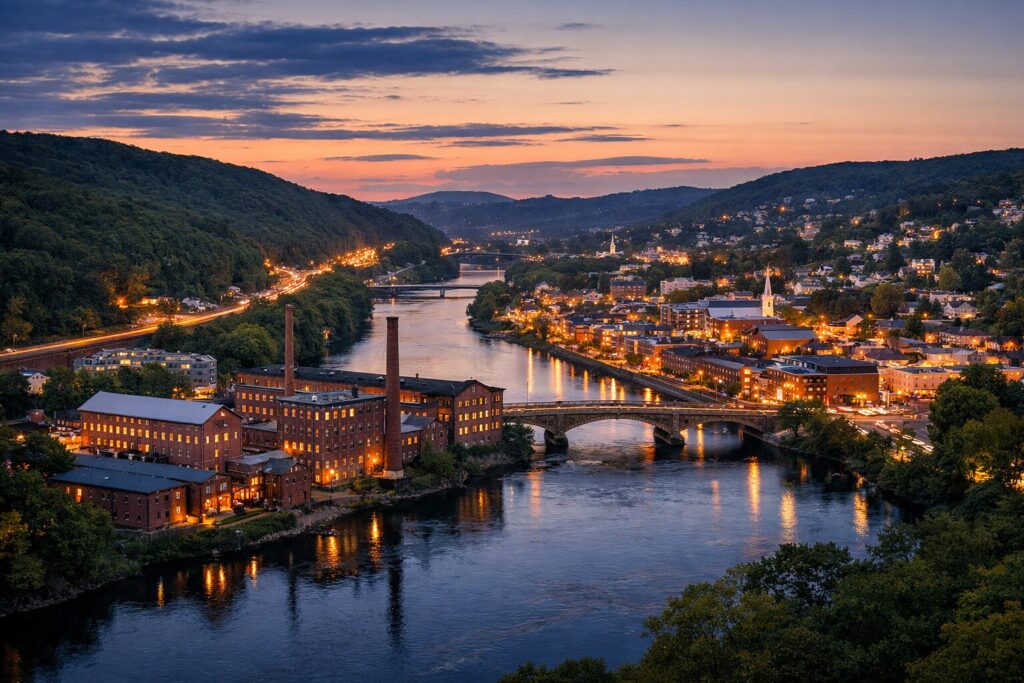
Most families in Connecticut carry the state’s economic history inside their own.
A grandfather who worked the line at a brass mill.
A grandmother who stitched hats or inspected parts.
A mother who built a career at Sikorsky Aircraft — not as a symbol, but as a steady paycheck that paid the mortgage, funded college, and anchored a family in place.
For decades, Connecticut offered something simple and powerful: stability. Work was local. Housing was attainable. A single income could support a household. You didn’t need to leave to build a life.
That world didn’t disappear overnight.
It faded — and what followed was not renewal, but pause.
The First Transition: When Manufacturing Slowed
By the late 1960s and into the 1970s, the forces reshaping American manufacturing began to reach Connecticut. Automation increased output with fewer workers. Global competition lowered costs elsewhere. Consolidation followed. Some plants modernized. Many closed.
Jobs were lost, but something deeper shifted too: confidence.
Communities built around factories didn’t immediately find replacements. Families adjusted quietly. Parents told their children to “have a backup plan.” Towns stopped expanding and started protecting what remained.
This was the beginning of what would become Connecticut’s defining economic mistake.
The 20-Year Stall No One Talks About
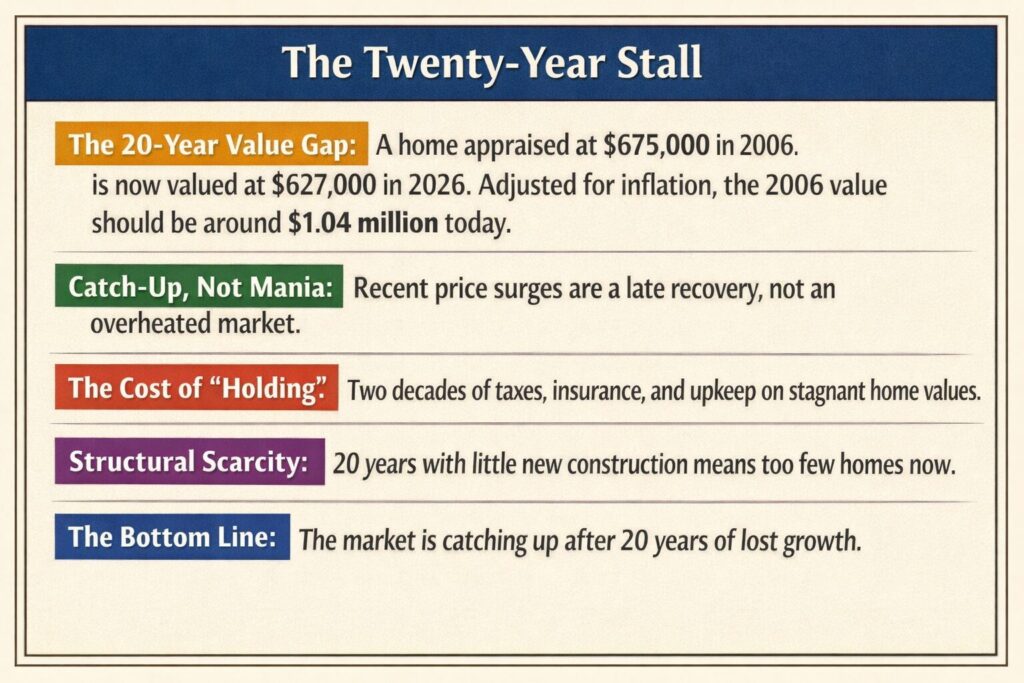
From roughly the mid-1990s through the mid-2010s, Connecticut entered a prolonged economic stall.
Not a collapse.
Not a boom.
A stall.
Job growth lagged national averages. Population growth flattened. Young adults left in steady numbers. Investment became cautious. Employers hesitated. Municipalities planned for maintenance, not growth.
Housing followed the same pattern.
For nearly twenty years, Connecticut dramatically underbuilt. Zoning tightened. Permitting slowed. Projects were delayed or scaled back. Towns assumed growth would not return — and in many places, actively planned against it.
This wasn’t driven by greed or ideology. It was driven by uncertainty.
After manufacturing declined, Connecticut didn’t replace it with a new growth engine. We waited. And while waiting felt prudent at the time, it carried a hidden cost.
While other regions built through cycles — sometimes too much, sometimes imperfectly — Connecticut largely stopped.
That decision compounded quietly, year after year.
Families Felt the Stall Before Economists Did
 This stall didn’t show up first in spreadsheets.
It showed up at kitchen tables.
Parents who hoped their children would stay nearby watched them leave.
Grandparents stayed in homes meant to anchor generations, only to see those chains break.
Women and men who built stable careers wondered whether the ladder would still exist for the next rung.
Housing became more conservative. Smaller. Scarcer. Less flexible. The assumption was no longer “Who’s coming next?” but “Let’s not risk too much.”
By the time growth returned, Connecticut had lost the habit of building for the future.
When the Bill Came Due
Growth did return — and it returned faster than expected.
Healthcare expanded. Universities grew. Distribution and logistics followed highways. Remote work untethered thousands of jobs from offices in New York and Boston. Young families rediscovered Connecticut’s schools, towns, and quality of life.
Then came artificial intelligence.
AI didn’t create Connecticut’s housing shortage.
It exposed the consequences of the 20-year stall.
Work began changing faster. Skills needed updating. Mobility mattered again. People needed flexibility — and flexibility requires housing.
But the homes weren’t there.
What feels like chaos today isn’t sudden demand. It’s twenty years of deferred supply colliding with a new economy all at once.
Why This Housing Crisis Feels So Raw
This is why today’s housing crisis feels personal and emotional.
It’s not just about prices.
It’s the adult child who wants to stay near aging parents but can’t find a home.
It’s the grandparent who hoped their house would hold three generations.
It’s the woman offered a job in Connecticut who turns it down because there’s nowhere to live.
It’s the worker who wants to retrain for a new economy but can’t risk losing housing stability.
This is what happens when an economy transitions — but housing doesn’t.
Housing Isn’t the Problem — It’s the Missing Platform
Every major economic transition eventually returns to the same truth:
People need somewhere to live before they can adapt.
Housing isn’t just shelter.
It’s economic infrastructure.
It’s family infrastructure.
Without enough housing:
- Labor markets seize up
- Employers struggle to hire
- Young families leave
- Communities age in place
With housing:
- Workers adapt instead of flee
- Families stay connected
- Towns regenerate
- Opportunity multiplies
This isn’t theory. Connecticut has lived it.
From Crisis to Engine — If We Choose To Build
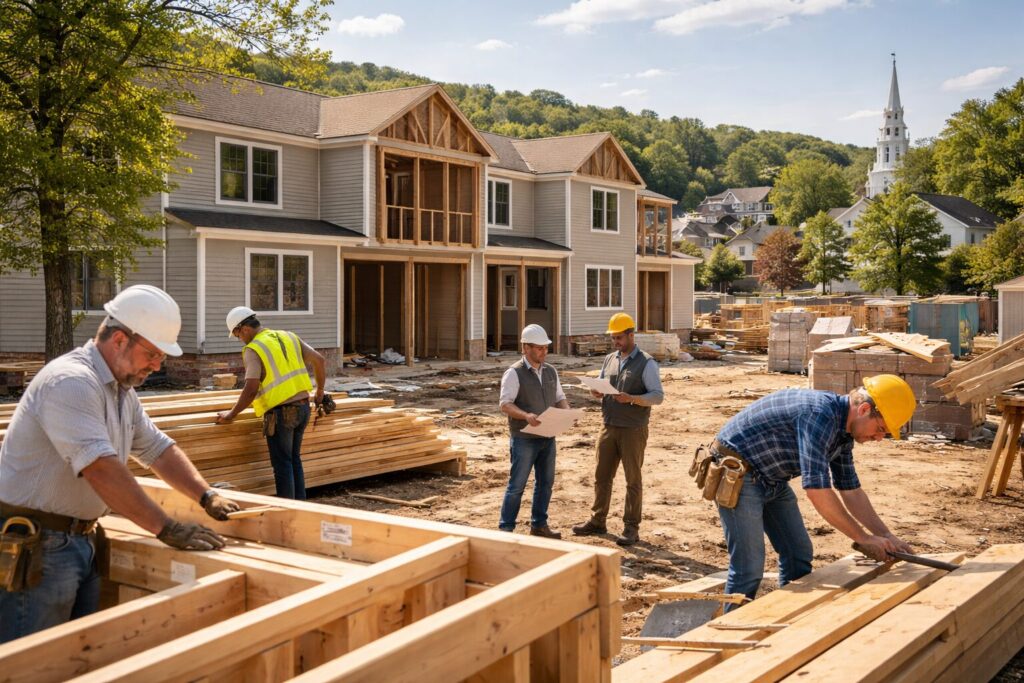 The housing shortage is a crisis — but it’s also an opportunity Connecticut hasn’t had in decades.
Building housing creates long-term construction and trade jobs. It supports manufacturing, materials, transportation, design, and local services. It expands tax bases and justifies infrastructure investment.
At a time when AI is automating information work, physical work becomes more valuable — not less.
You can’t automate a foundation.
You can’t offshore a water main.
You can’t raise a family in a data center.
Housing is how economic change becomes livable.
Cities That Know What a Stall Feels Like
Some Connecticut cities understand this moment more clearly because they’ve already paid the price of waiting.
Along Route 8, former manufacturing centers endured decades of decline before stabilization even began.
Derby is one example among many.
Derby doesn’t need to reinvent itself. It needs to complete its transition — reconnecting housing, work, and place after decades of disruption. For cities like this, housing isn’t a threat. It’s the missing piece.
Education, Work, and the Next Generation
 The next economy won’t replace people with machines. It will reshape how people work.
AI will handle data and automation. Humans will still build, repair, teach, care, and lead. Education must reflect that reality — faster retraining, modern trades, and pathways that let people stay rooted in their communities.
Housing is what makes that possible.
Without it, adaptation is theoretical.
With it, change becomes survivable.
What This Moment Is Asking of Connecticut
Connecticut isn’t failing.
It’s finishing a transition that began decades ago.
The real mistake wasn’t manufacturing’s decline. It was allowing the 20-year stall to harden into policy, zoning, and expectation.
Now the choice is clearer.
We can keep reacting — or we can finally build for the economy we already have, not the one we lost.
Housing is not a side issue. It’s the foundation that allows families, workers, and communities to move forward together.
Connecticut isn’t broken.
It’s transitioning.
This time, we understand what that means — and what it will cost if we ignore it again.
Share this:
- Email a link to a friend (Opens in new window) Email
- Print (Opens in new window) Print
- Share on Instagram (Opens in new window) Instagram
- Tweet

- Share on Telegram (Opens in new window) Telegram
- Share on Tumblr
- Share on Reddit (Opens in new window) Reddit
- Share on WhatsApp (Opens in new window) WhatsApp
